
Translated from Spanish by Robin Myers
Published by Charco Press, 2024, 157 pages. Original version published in 2019.
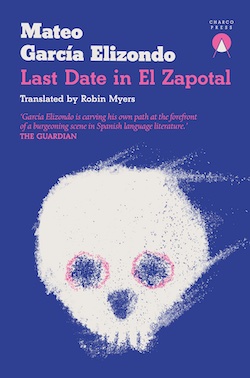
“I’d say you start existing in a kind of limbo. That’s where I live now, that’s what this whole town is: limbo. That’s what heroin is too. You’re halfway between the world of the living and the world of the dead, and neither wants to deal with you.”
The nameless narrator of this book is a junkie, one who has lost everything except the desire for the next fix. He comes to what he thinks is the end of the earth, El Zapotal, to shoot up one more time and die. But that final dose evades him, and he ends up wandering through the streets of El Zapotal—where he is clearly not wanted—like a walking corpse.
He chooses El Zapotal because he knows no one will find him there and try to revive him. Because he does not want to be revived, something that has happened often. He hires a room where he feels that he can get some peace, but eventually his rent becomes overdue and the landlord kicks him out. People refuse to talk to him and pretend not to see him.
He exists in a kind of dream, remembering the past: Valerie, the woman he loved and whom he introduced to drugs and who died from an overdose; Kid, the stray dog that he adopted and then abandoned; and his friends, many of whom are now dead.
He spends his time searching for the Lady—that’s what he calls heroin with which he has a kind of love affair—because the final syringe that he had filled up got left behind in his room when he was thrown out. He goes to the local dive, El Rincón de Juan, hoping to score some heroin there, but they don’t have it.
He keeps bumping into the dead—both those he knew and those he didn’t. One of them, Señor Sierra, tells him to go to his house and dig up valuables that he had buried beneath a tree and give them to his wife and daughter. Which he does, more to prove to himself that he is not crazy and imagining things.
This is a dreamlike book, where nothing much happens. You are in the narrator’s head, and you know exactly how he feels—the withdrawal, the overwhelming need, the relief when he finds a drug, whether it is opium or heroin. I did not ever think I would be so completely absorbed in a book about a junkie, but Mateo García Elizondo’s writing pulls you in (as does the excellent translation by Robin Myers).
This is not just about what the narrator is going through physically. There is also depth and sadness here, and loneliness. Remembering his past, he thinks that it wasn’t the drug that calmed him down, but being surrounded by his friends. “Drugs only meant that my friends would always there, would always come back, would never abandon me.”
The language is sometimes lyrical. Towards the end of the book, he sees a woman bathing in a river. “I stayed for a bit to watch—not even with lust, but as you’d listen to a sad song that evokes some beautiful faraway time you didn’t fully enjoy in the moment and have now lost forever.”
García Elizondo writes about death and life and the space in between, what the Tibetans call the Bardo. It is a book that haunted me. It does not have much of a plot but it is deep and thought-provoking. García Elizondo uses the last days of a junkie to tell an story that is much more than one man’s search for death.

