
Published by L’Iconoclaste, 2023, 581 pages. Published in English as Watching Over Her, Simon & Schuster, 2026.
Translated from French by Frank Wynne
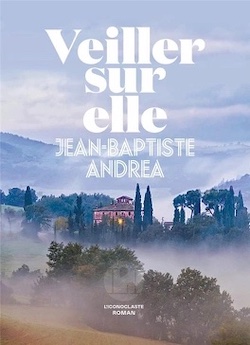
An old man lies dying in the abbey, Sacra di San Michele in Piedmont, Italy, watched over by 32 monks. The man, Mimo Vitaliani, has lived in the monastery for 40 years, but no one knows why: he is not a monk, has never taken vows. A rumour has it that he is “watching over her”. “She” is a statue, a Pietà that Mimo carved, a statue that is locked away in the depths of the Sacra di San Michele and must never be seen by the public.
As he lies there, close to death, he tries to say something. The abbot is summoned, but all he can make out is “violin, violin”—surprising because Mimo has not been known to be musical. But Mimo is about to tell the story of his life and his great love, Viola Orsini. And no one—except for the readers of this book—can hear him.
Mimo was born in 1904, the dwarf son of a sculptor and his wife, both Italians living in France. He is named Michelangelo, but the boy prefers to be known as Mimo. His father is conscripted to fight in the First World War and is killed. When he is 12, Mimo’s mother sends him to live with Zio (uncle), Alberto, who isn’t really an uncle. He is a sculptor and takes Mimo on as an apprentice.
But Zio Alberto does not like Mimo—or anyone else for that matter—and does not treat him well. Especially when he realizes that the child has more talent than he will ever have. When Mimo is 16, they move to Pietra d’Alba, a village in Liguria. That is where he meets the three people who will be part of his life for a long time: Alinéa or Vittorio, as he prefers to be known; his twin brother Emanuele; and the great love of Mimo’s life, Viola Orsini. The four of them are around the same age; Vittorio, like Mimo, works for Zio Alberto.
Viola is the daughter of the aristocratic family with the big house in the village. Mimo sees her for the first time in the cemetery at night, when he is dared by Vittorio and Emanuele to enter. Terrified by the sudden appearance of a figure veiled in black, he takes her for a ghost. Then one day, working on the Orsinis’ rooftop, he falls over and saves himself by crashing into her window. That begins a deep friendship that lasts for the rest of their lives.
Viola and Mimo are both misfits—he is poor and extremely talented, and she is bright and ambitious, a voracious reader who can remember everything she reads, but born at a time when women’s only role was to marry and produce children. They declare themselves to be cosmic twins and form an instant bond. Viola is appalled by Mimo’s lack of knowledge and starts sneaking him books from her father’s library.
Eventually, their paths take them away from each other. Mimo is sent by Zio Alberto to Florence to take on an apprenticeship with Metti, a sculptor. Mimo falls foul of a young man who works there, the son of a rich father, and ends up on the street. He joins a circus where he performs for the crowds but also finds a sort of family.
His path takes him back to San Pietro, where he is hired to work for the Orsinis. Viola is now married, but her husband is frequently away, so she has a certain amount of freedom, for a while at least. Fascism has come to Italy, and one of Viola’s brothers, Stefano, has joined Mussolini, while the other brother, Francesco, has become a priest of some importance. Mimo becomes a successful sculptor with several orders from important people, including from the Fascist government. Viola is horrified, but Mimo sees himself primarily as an artist and therefore apolitical.
But it never is that simple. The Fascists fall, Mussolini is strung up, and people collaborating with the regime come under fire. And then a cataclysm changes Mimo’s life forever.
This is one of the best books I’ve read this year. Jean-Baptiste Andrea creates a world that is completely believable with characters that you care about: not just Mimo and Viola, but also Vittorio, his wife Anna, and his twin brother Emanuele, who only Vittorio can understand and who walks around in mismatched uniforms that people give him. There is Viola’s family: the Marquis and Marquise, living in a world that is slowly being overtaken; Stefano, a lover of drink and women and who spends his life trying to fill the hole left by his eldest brother’s death at the start of the World War I; and Francesco, the priest who becomes the Pope’s right-hand man, and who is a friend to Viola and Mimo. Not to mention all the people who are a part of Mimo’s life in Florence. Each character is carefully drawn and you feel you know these people.
The book is extremely well-written: the descriptions of places bring them to life. But it is much more than that. It raises questions about art and artists: can artists truly be apolitical?[1] What does it mean if the artist works for a fascist regime? This is also the story of a century in the life of a country. Towards the end, you can see a glimmer of freedom for women: Viola wants to stand for office—this is now possible, although she is mocked by Stefano and her husband; and Anna leaves Vittorio to make a life of her own.
This is a rich book and a pleasure to read. I knew from the first page that it was going to be good and it completely hooked me. If you have not discovered it yet, you should. You won’t regret it.
[1] A question also raised in Daniel Kehlmann’s The Director and Klaus Mann’s Mephisto.

