
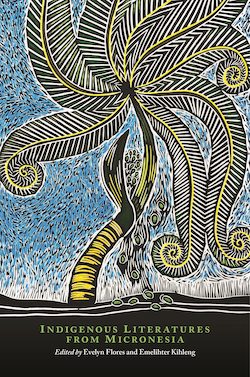
Published by University of Hawai’i Press, 2019, 358 pages
“The work remains of breaking down myths and building up re-visioned ones that empower rather than demean. It remains to tell new stories that are really ancient ones, persisting in our blood, paradoxically and endearingly both familiar and breathtakingly novel, stories that deconstruct the lies and half-truths that we’ve come to believe. This purpose has never changed. We must bring those narratives, our histories and imaginations, home. We must return our children to their foremothers and forefathers.”
—Evelyn Flores, Preface
To rule over colonized people, the colonizers make themselves out to be better than them in every way; the culture and heritage of the colonized is thus made out to be not just inferior, but “savage”, “uncivilized”. They are forbidden from speaking their own languages and practicing their rites.
This anthology from the region of Micronesia[1] aims to remedy this, to undo the damage that was done and to restore the indigenous cultures and languages to the centre of people’s lives. The anthology also puts paid to the idea that Micronesia “lacked” a written literature, as this book demonstrates with its mix of fiction, non-fiction, plays and poetry. The writers are from around the region, with several from Guåhan. The writings cover nine of the thirteen language groups of Micronesia; in some cases, we also have the original, along with translations into English.
The book is divided into seven sections: Origins, Resistance, Remembering, Voyages, Identities, Family, and New Micronesia. Origins consists mostly of poems that tell the creation myths about how the islands were formed, and recount stories. Teweiariki Teaero (Kiribati) consoles children scared of a thunderstorm, saying that “Up there in Matang / The ancestors are partying / That is all they do” (Merry Ancestors). Canisius Filibert (Belau) writes about when his ancestors told time “By counting moons / They watched sunrises / No one needed hours / Nor tiny little seconds / Days were enough / Shadows told time”.
Then the colonizers come, something that is dealt with in Resistance. In Forefathers, Anne Perez Hattori from Guåhan wonders why the forefathers she learns about in school are so different from her: “With their white-wigged hair / and exquisite accents”. For the island children, George Washington, Thomas Jefferson and other American figures are alien—they are not their ancestors, but foreigners. John Mangafel from Yap (an island state in the Federated States of Micronesia) addresses The Lord’s Prayer to “Our Fathers, who art in Washington” and asks for “our quarterly allotment / And forgive us our over-runs”.
Remembering includes History Project by Kathy Jetñil-Kijiner (Marshall Islands)[2] about how her islands were used for the testing of nuclear bombs; an extract from An Ocean in a Cup, a novel by Stephen Temorio Jr (Guåhan) that goes back to how it must have been for Chamorro islanders at the turn of the century; and an extract from Mariquita: A Tragedy of Guam by Chris Perez Howard (Guåhan), about a young woman whose plans for happiness with her love are destroyed when Guåhan is invaded by the Japanese. This is the story of the author’s mother, the mother he never knew.
In Identities, Micronesians in the US try to forge their identities amid insults about the way they look and speak: “So insignificant, backward, indigenous” as Jelovea Seymour (Kosrae and Chuuk) writes in Kaki Se (a coconut). In Language with an Attitude, Palauan Identity with an English Accent, Isebong M. Asang (Belau) writes about being educated in Western ways. It is not just Standard English (which she has to learn if she wants to get a job) but much more. The Western way of not wasting time, hurrying on to the next thing, is not the way of the islanders. Asang writes about omelengmes, the “language of social and economic order for Palauans”, the belief that there is a time and place for everything. The Westerners view this as young people keeping quiet and knowing their place. But that is not the case. Omelengmes implies that children learn through observation and encourages them towards adult responsibility from a young age. This is an example—and there are many—of the reductionist view of island culture.
I could go on, but this review would become very long. The examples I have used just give an indication of the works in this collection. Although many of the pieces are quite specific to a place, they also echo the wider issues facing the region: the damage done by colonizers and invaders, to the people, the land and the culture; and the pride that Micronesians have in recovering their identities, in returning to their roots.
This is an anthology whose time has come. Micronesia has long been neglected in world literature. It is a vast region: 2,000 islands spread over 3 million square miles of ocean. We need to hear these voices, these stories, and learn more about the people of these islands. The variety in this collection—the diversity in styles, in language—bears witness to the richness of the region’s literature.
For me, this book was a real find. It has introduced me to several writers from the region, and I will be looking for more of their writings.
[1] The region of Micronesia includes the Federated States of Micronesia, Palau, Naoero, Kiribati, the Marshall Islands, Guam and the Mariana Islands (the last two are jurisdictions of the United States). The names of countries and islands are given in the original language in the book, so Guam is Guåhan, and Palau is Belau. I will use these, and also Nauru’s new name, Naoero.
[2] See my review of Kathy Jetñil-Kijiner’s collection, Iep Jāltok—Poems from a Marshallese Daughter.


Pingback: Iep Jāltok—Poems from a Marshallese Daughter: Kathy Jetn̄il-Kijiner – Talking About Books