
Published by Jonathan Cape, 2025, 301 pages
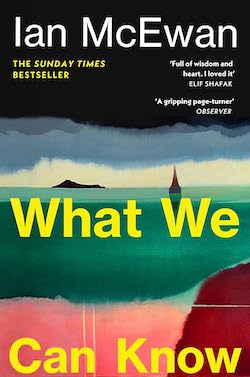
The United Kingdom, 2119. Tom Metcalfe, an academic, studies the 1990s to the 2030s, a period he romanticizes. Looking back, this was a time of plenty: when you could go into a supermarket and buy anything you wanted, walk for miles on dry ground, and be surrounded by an abundance of species.
The world in 2119 is very different. There was a climate catastrophe in the 2030s. In 2042, in a pre-emptive strike by Russia, a large hydrogen bomb aimed at military installations in New Mexico landed in the Atlantic. The bomb caused 70-foot waves around Europe, West Africa and North America. The inundation resulted in the loss of much of the coastal landmass. The UK is an archipelago: only the areas on high ground have survived. People have adjusted to their new circumstances, and soon the results of the catastrophe become a part of everyday life.
The Derangement, which refers to the early 21st century, when warnings of climate change were ignored, led to catastrophe. Various wars around the world added to this: between India and Pakistan, China and the US, and Saudi Arabia and Israel against Iran. By 2119, the US has become a country of battling warlords, and Nigeria dominates the world.
In universities, humanities have been delegated to the sidelines. Tom and his on-off partner Rose, who also teaches the same period, try to interest the students in the past, but without much success. As far as the students are concerned, the people living in the late 20th and early 21th centuries were criminally irresponsible and to blame for many of the disasters that followed.
Tom, however, is fascinated by the period, especially a lost poem by Francis Bundy, a poet said to be on par with Seamus Heaney. In 2014, for his wife Vivien’s 54th birthday, Francis writes a poem for her, A Corona for Vivien. He makes a single copy on vellum, and reads it out at Vivien’s birthday party.
The party was now known as the Second Immortal Dinner (the first was held in 1817 with William Wordsworth, John Keats and Charles Lamb). At the party were a well-known novelist and her husband; Francis’s sister and her husband, who was also his editor; a professor of botany and his partner, a vet; and a journalist who had interviewed Francis for Vanity Fair and her husband.
This is the audience to whom Francis reads his long poem to Vivien. He then presents Vivien with the only copy. The poem is never seen again. It has become a holy grail for scholars, who still write about it a century later. The poem was said to describe animals and plants of the time, and so it has become more than just a poem: it is also a catalogue of the rich variety of species of the past.
The night of the dinner is an eventful evening, and we get a detailed account from Tom about it—what is said, what is eaten and how the events play out. Scholars of the future are able to piece together our lives, thanks to our digital footprint—emails, social media, and so on. What Tom cannot glean from this, he makes up, which appals Rose. The version we get of the dinner is Tom’s, some gleaned from the material and the rest from his imagination. You get carried away by the story, not caring where the facts end and the actually story-telling begins.
Then Tom is led to a clue that indicates where the poem might be buried, and he and Rose hire a boat and set off to find it. What they uncover upends many of the things they had believed.
The first part of the book centres on Tom in 2119, and on Francis and Vivien, seen from Tom’s point of view. The second half is about the contents of the box Tom and Rose find buried near the Bundys’ house. To reveal more would be a spoiler.
This is a book about the traces we leave behind—not only the digital detritus but also the consequences of our actions. The Derangement was humanity’s doing, the refusal to pay attention to the unfolding climate catastrophe and to make the world safe for the generations to come. The world in 2119 has shrunk—fresh food is not readily available, and people live on protein pills and bars, and acorn coffee. There are far fewer species, and to go from place to place means taking boats. Rare minerals have been depleted, affecting the availability of technology. It is interesting to see our present from the perspective of the future and understand how good we have had it, and what a mess we have created.
There are also the pitfalls of assuming a complete knowledge based on incomplete evidence. Tom immerses himself in the details of the dinner party, reading everything he can find, no matter how trivial. He feels he knows the people at the dinner party intimately, especially Francis and Vivien. But as he later discovers, not everything can be gleaned from the online world—there is much more to their stories and the relationships that bind this group of people than he could have imagined.
Ian McEwan tells the story with his usual skill. When I started reading this book, I was expecting climate fiction, but it is more than that. The story of Vivien, Francis and their group is as important as Tom’s. It is a story of love and betrayals, of secrets and pain, and of the appropriation of memories.
This is a book about how we remember, and how we are remembered. It is also a warning about the path humanity is currently on and where it will eventually lead us.

