
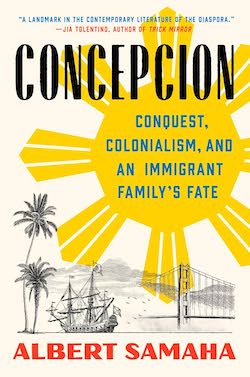
Published by Riverhead Books / Centre Point Pub, 2021, 384 pages. Published in the US as Concepcion: An Immigrant Family’s Fortunes.
“Our stories guide and protect us. Without their lessons, warnings, and triumphs to root us to the past, we float aimlessly, taken by whatever opportunistic forces are quickest to grab, mold, and exploit.”
Albert Samaha’s mother is from the Philippines and his father Lebanese. His father did not feel he could tell his people about his Filipina wife, although he did provide for them financially. The result is that Samaha grew up with his mother’s family.
Samaha was born in the US. His family started immigrating to the US from the Philippines in 1957, with his mother’s sister being the first. She then helped other family members to move. Samaha uses his family’s story as a diving board for the history of the Philippines and the US.
Samaha’s family were doing well in the Philippines. They were wealthy, with big houses and domestic staff. Moving to the US meant that they had to work hard at jobs that did not pay much—the sacrifice that many first-generation immigrants make for their children. His uncle Spanky, for example, was a rock star and a media celebrity in the Philippines. When he eventually decided to move to the US, he found work as a baggage handler at an airport.
Why did they move? So that their children would be better off, would have better opportunities, they would have better social institutions, better schools… The stories they had been hearing about the American dream and success had to have some basis in fact. Of course, reality turned out to be much harsher.
The contrast between the two lives is stark. “In the States, life felt shaky, cramped, rushed, an endless series of complications, adjustments, and sacrifices. At the dinner table, the adults talked of job applications, used car ads, loved ones awaiting green cards—ambitions, next steps, always more to do to reach the bright future that lay before them. There were no maids to cook for them, no drivers to ferry the kids to school. Everyone seemed to be toiling all the time.”
We get to know the family. His uncle Sparky, who gave up a life of fame, never lost his good humour. His granduncle Tomas tried to help topple the Marcos regime, and later moved to Italy. He was the one who told Samaha stories about his family’s past. Samaha’s mother Lucy, whom he loves dearly, made sacrifices to give Samaha a future in the US, sacrifices he sometimes worries might have been too great. As she gets older, Lucy starts believing in conspiracy theories, and nothing he can say helps change her mind. It is a look at how—and why—people believe conspiracy theories, ideas that make no sense to those who don’t buy into them.
But Samaha has a larger canvas. This is a story of migration on a wider scale. A hundred thousand years ago, people migrated north from Africa to the Arabian Peninsula into Asia, or along the Mediterranean to Europe; or south into Africa, with limits being set by whatever transportation they had.
The first settlers in the Philippines formed self-governing villages united by kinship. These were called barangay, named after the sailing boats in which the people had arrived on the archipelago. They built rice terraces that would stand for 3,000 years, crafted intricate gold jewellery, and found ways of cleaning clothes with citrus. Like so many other people who co-existed with nature, they understood the land and had a healthy respect for the natural world—and the dwendes, the dwarves of the forest, whom it was best not to annoy.
The barangays did well. In the 11th century, one of them reached out to the Imperial Chinese Emperor, which led to trade. Then Ferdinand Magellan landed on the archipelago, and that opened the way for the Spanish colonizers in the 1500s.
Samaha traces the history of the archipelago under the colonizers and the conversion to Christianity. Then, during World War II, the Japanese came, and were followed by the Americans. Samaha has researched his family history, and writes about how his relatives were involved in some of the major events, such as rebellions against the colonial powers and resistance against the Japanese.
But Samaha is also a child of the US. Parallel to the history of the Philippines, he also narrates the history of the US. He traces the waves of immigrants to the United States over the years, sometimes as a result of the US involved in wars overseas, like Vietnam and Korea. These people built communities and support systems in places where they settled, “pooling resources, sharing roofs, sending dollars back to relatives who stayed behind”.
Although I felt I knew the US part of the book better, some of the facts he shares are eye-opening. The US does not mandate paid sick leave, and is only one of three countries of the Organisation for Economic Co-operation and Development (OECD) where the minimum wage has not risen for the last 20 years.
Samaha interweaves all these threads, making history personal through his family. This is their story, the story of how a family stuck together through good times and bad, a story of bravery, of somehow making good in the face of often insurmountable odds. A family that tells stories around the dinner table, where newcomers are always welcomed by those already there. It emphasizes the importance of these things.
As a journalist, Samaha is well-placed to tell this story. It is clear that there is a great deal of research behind this book, but it comes alive through Samaha’s family and their experiences. This is a book well worth reading.

