
Translated from Estonian by Adam Cullen
Published by Pushkin Press / Peter Owen Publishers, 2015, 364 pages. Original version published in 2010.
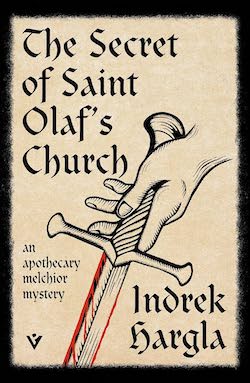
Tallinn, 1409. A knight is beheaded and the murderer walks away, leaving no trace.
To put the story into context: sea traffic between Estonia, Germany and Scandinavia was at an unprecedented level. This was the golden age of the Hanseatic League—a network of merchant guilds in Central and Southern Europe—and the Teutonic Order had consolidated its power. Tallinn was being built, and the Order ruled the town from Toompea Castle, which was situated nearby and manned by its own sentries.
A pirate group, known as the Victual Brothers, had been terrorizing the Estonian coast, not only looting but brutally murdering people. The Teutonic Order hunted them down and killed all the pirates they captured.
One evening, Henning von Clingenstain, former Commander of the Teutonic Order in Gotland, is passing through Toompea. He is out drinking and staggers home, only to be accosted by someone from his past. The person beheads him and leaves a coin, an old Gotland ørtug, in his mouth. Later, the sword used is found outside the castle walls.
By morning, the news of the murder is all over town. The Magistrate of Tallinn Town Council, Wenzel Dorn, asks the apothecary Melchior Wakenstede to help him. Melchior has helped Dorn before: he is observant and, as apothecary to the town, privy to a lot of secrets.
Melchior is puzzled by the crime. Why was an old coin, not in use anymore, stuffed into the knight’s mouth? And what happened to the expensive gold collar the knight was wearing? He is convinced it is not an outsider: the castle is carefully guarded, and no stranger would be allowed access.
Then the Master Builder is beheaded, also with a coin left in his mouth. Is it the same murderer? Melchior is doubtful it is. For one, the coin is not the same type as in the earlier murder. Could the Master Builder’s death have something to do with the superstitious belief that all the master builders working on St. Olaf’s church will die?
In the midst of all this, there is the Smeckeldach competition, where brewers of beer compete with each other. The competition goes ahead in spite of the deaths because of all the work already put into the brewing. The Dominicans are sure to win because of Brother Wunbaldus’s incredible touch with brewing. But there is a death at the competition, which is made to look like an accident, but Melchior realizes is murder.
Will Melchior be able to solve the crimes before more people are killed?
Indrek Hargla is a well-known Estonian writer of crime novels and science fiction. He brings Tallinn in the 15th century to life. You get a sense of how its society functions and its history, as well as the way Tallinn was built. There are a few points where it drags—for example, the scene at the Smeckeldach where a drunk priest recounts a story is not really relevant to the plot and goes on for too long.
But this is an enjoyable book and a great introduction to an interesting historical period.
 Talking About Books