
Published by Jonathan Cape London / Random House, 2025, 254 pages
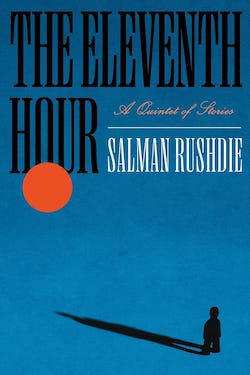
This is Salman Rushdie’s latest book, a collection of three longish stories bookended by two short ones. Given the attack on him that almost killed him and the fact that he is now 78, it is not surprising that many of the stories deal with old age and running out of time.
In the South is a touching story about two old men, neighbours with adjoining balconies, two men with a shared name but one of whom is 17 days older than the other. They are friends, although they spend their time bickering with each other. Their words do not sting: they are a ritual, and hide the affection that Senior and Junior feel for each other, something neither of them would ever admit to. They rely on each other to banish the loneliness each of them feels. This is a story about getting old, with the aches and pains and unsteadiness it brings, and the realization that your world is getting smaller. And death is around the corner. But as Senior muses towards the end of the story, “Death and life were just adjacent verandas”.
For the next story, Rushdie returns to his old neighbourhood in Mumbai, the setting for Midnight’s Children. The Musician of Kahani is about Chandni, a prodigal musician. She is able play any instrument and has an incredible gift for both Indian and Western classical music. She and her parents form a tight family unit until her father Raheem falls under the spell of a Rajneesh-like character, Gurushankar (complete with 93 Ferraris!). He leaves his family to follow Gurushankar and become a cook at his ashram. Meanwhile, Chandni falls in love with Majnoo, the scion of an extremely rich family and marries him. Her marriage changes everything: all that is expected of her now is to produce an heir, and once she is pregnant, the family swings into action. She ends up being locked up in the house with her mother, while her mother-in-law organizes an extravaganza with major artists performing. But things do not go to plan. And Chandni by then has realized that she can use music—Indian classical music which has space for improvisation—to bend events to her will. A power that she uses to get back at those who have hurt her.
Late is a ghost story— S.M. Arthur, a Cambridge professor, has died. His ghost inhabits a sort of limbo, confined to the college grounds. Only Rosa, a young Indian woman—part of the first batch of women admitted to the college—can see him. Arthur never fulfilled his promise as a writer: after his first acclaimed novel, he never wrote anything else. Together, Rosa and Arthur plan the downfall of the man who tormented him. The professor has echoes of E.M. Forster and Alan Turing, and story raises some of the issues that both men faced, especially the stigma against homosexuality.
Then the stories start to flag. Oklahoma is a metafiction piece by a fictional writer known only as Mamouli Ajeeb (Ordinary Special) or M.A. and deals with obsession and the creation of fiction. The story is about M.A.’s obsession with an older writer, known as Uncle K. When Uncle K. disappears, leaving all his clothes on the beach, M.A. is determined to find out whether he is dead or alive, whether he committed suicide or staged his disappearance. The story feels fragmented—especially when the two short pieces supposedly mailed by Uncle K. to M.A. appear halfway through.
Freedom of speech and censorship are the themes in the last story, The Old Man in the Piazza, set in an unnamed country. Language is depicted as a young woman in the piazza. The old man sitting there watches as she is constrained and mistreated; he watches her sulk, refusing to fly or soar. Until one day, she has had enough and stands up and shrieks—a shriek that destroys the buildings in the piazza, and the old man finds his words drying up.
I really enjoyed the first three stories, especially In the South (my personal favourite in this collection) and The Musician of Kahani, where Rushdie’s storytelling really comes to the fore. But I found Oklahoma overblown and The Old Man in the Piazza too obvious and contrived.
Having said that, the first three are worth getting the book for. And I am glad that Rushdie is still writing, defying those who would see him silenced. I hope he keeps writing!


Rushdie is a huge gap for me even though I bought The Satanic Verses in hardcover! (The only one I’ve read is Haroun and the Sea of Stories… oh, a couple of essays along the way, that’s it.) You know how sometimes it just reaches a point where it seems impossible to begin, because you’ve not begun yet? But I really should just buy one and start.
He’s not easy. Maybe Satanic Verses is not the one to start with. Start with Midnight’s Children or The Moor’s Last Sigh. When Midnight’s Children came out, it felt like Rushdie had blown fresh air into Indian writing. I remember thinking, oh you can write like that? He uses Hindi words–one of the first to use non-English words in English writing (as far as I know), something that is much more common now. He also uses magic realism. I’m a big fan, although not all his books are that good.
I can imagine how it must have felt at that time! He has consistently been such a towering figure. I remember reading an essay about how, whenever a book in their family home was dropped, they would kiss the book. Sometimes, because of this, I do; always, because of this, I apologise to the book for my offense! So Rushdie has been with me through much of my reading life, in this way.
Neither of the ones you’ve suggested are in my (currently small, somewhat remote) public library, but I will look for copies elsewhere, Thank you! (They have Quichotte, Victory City, The Golden House, Two Years…, Luka…, this collection, and some non-fiction).
I think of his novels as being like Amitav Ghosh’s, but with some “magical/spiritual” elements… all that history and detail, extensive family and community relationships, political commentary baked right into the story (I see we both enjoy Ghosh too, via your previous reviews)? I could be wrong…
Marcie, I believe Victory City is very good. I have it on my shelf but have not read it. If you search for Rushdie on my blog, there are more reviews. I enjoy Amitav Ghosh, but the review was written by someone else, and I have not read that book.