
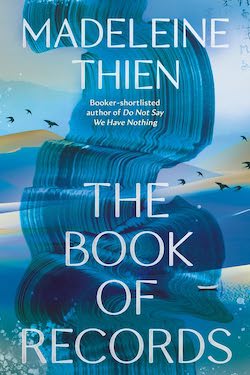
Published by Granta Books / W.W. Norton & Company, 2025, 368 pages
“The only way to really remember is to forget everything and let time fill the story up. To reach it through a different doorway. Things have to inhabit the living or else disappear from the world and cease to exist. If things survive it’s not through abstract thought, but the realities that gave rise to those thoughts.”
A father and his daughter reach the Sea, a huge centre for refugees by an unnamed sea, where people wait for a passage out. Wui Shin and seven-year-old Lina have fled their hometown of Foshan, leaving behind Lina’s mother, brother and grandmother. Climate change has made large parts of their country unliveable, and they are looking for a safer place. The hope is that the family will be reunited at some point.
But the years pass, and Wui Shin and Lina remain at the Sea. Wui Shin is too sick to travel. The only books that the pair brought with them are three volumes from a 90-volume set called The Great Lives of Voyagers: volumes 3 (Du Fu, said to be one of China’s greatest poets), 70 (the philosopher Baruch Spinoza) and 84 (the historian and philosopher Hannah Arendt).
Lina watches people disembark from ships and then board other ships to leave for a new life, a happening as regular as the seasons. They leave their belongings behind, which Lina collects: water filters, woodblocks for paper, extra clothes—things that can be used or traded.
The Sea transcends time and place. People have come from all over, and everyone is convinced they know which sea is lapping the shores: some insist it’s the Baltic Sea, others say it’s the Atlantic, and still others believe it to be the South China Sea. Lina’s father tries to explain it: “Everyone passes through the Sea. After these buildings, histories break apart. … The Sea is a length of string crossing over itself. The Sea is made of time.”
Lina and Wui Shi find a room on the 12th floor. Their neighbours become their family: an old man called Jupiter, a 60-year-old woman called Blucher, and Bento, a 40-year-old man. Each of the neighbours starts to narrate their own story. It eventually becomes clear that they are recounting the stories of the three people in Lina’s books. Jupiter is really Du Fu, a poet trying to eke out a living during the Tang Dynasty; Blucher is Hannah Arendt, fleeing the Nazis with her husband; and Bento is Spinoza, a Jewish scholar cast out from his community in 17th century Amsterdam.
Their stories bring these historical figures to life: Du Fu’s poverty and his attempts to get a job as an official, scuppered by a rebellion; Spinoza, cut off from all that is familiar because he said that the Holy Book was a book of stories written by men; and Arendt, fleeing from Paris with her husband, trying to find a way to America.
The book revolves around these stories, as it moves between Du Fu, Spinoza and Arendt, and the Sea. The second section, The Ethics, takes us to Wui Shin’s story, and why he and Lina had to leave and why his beloved wife Bee was not with them. Wui Shin worked for the government as a security engineer in cyberspace. He was manipulated by the state into creating a tool to restrict the internet, as well as into spying for the government. He refuses to see how his actions were betraying his principles as well as those closest to him. Until it is too late. He tells Lina that exile was better than continuing to live in “an empire in ruins, a hall of mirrors in which good people could betray themselves and never even know it”.
Madeleine Thien’s talent for storytelling is evident, as she weaves all these different strands together, moving between time and place. There are big themes here: the importance of ideas as well as of stories; displacement and the loss of home; refugees and climate change; and the inherent violence of authoritarian states. Conversations on the 12th floor often revolve around identity, freedom and language.
The Sea has no geographical location: like the sea that surrounds it, it is different things to different people. It is a place where time loops in on itself. Those living there are displaced in many ways: from their home and from their time. Some of them will never leave. The Sea can also be seen as a state of mind.
In a sense, Lina’s complete absorption in the three volumes she and her father brought with them reflects this. Her neighbours must be figments of her imagination, but nowhere in the book is this made explicit. It doesn’t need to be. When we leave everything behind, we cling to whatever we have been able to salvage, and use our imaginations to deal with loneliness. To Lina, these people are as real as her parents.
Lina is the heart of the book: intelligent, curious, resilient—a child who has to care for her sick parent while dealing with the heartbreak of being separated from the rest of her family. She is the one who narrates most of the book, and it is her voice that resonates throughout.
The title of the book echoes something in Thien’s earlier book, Do Not Say We Have Nothing: stories of a family are recorded in a handwritten notebook called The Book of Records.
This is an engrossing book, beautifully written, and one that will transport you across time.


Pingback: Do Not Say We Have Nothing: Madeleine Thien – Talking About Books
Ohhh, I really loved reading this. Thien is one of my favourite writers, and this book was one of my favourites from last year. Even while I was still reading it, I was looking forward to rereading it. You seem to have located a little more security in some of the story elements than I did (you seem sure that the “neighbours” didn’t really exist, for instance?), but I think one of the strengths of her writing is that she leaves enough space for the reader to truly engage, connect, and explore in a story that is hers but, then, it becomes yours too. I wrote about it here, exploring a few of the layers that most intrigued me. If you have not already, I suspect you would admire her husband’s novels and stories as well? Rawi Hage?
I loved the book too. And the way, as you say, Thien leaves space for the reader to make it their own. Maybe the neighbours were real—the Sea feels like a liminal space, so it is possible. I enjoyed your piece about it and the way you described books opening into others. I have not read her husband’s books but will check them out. Thanks!
His 2006 novel has been greatly acclaimed, but if the description does not immediately appeal, don’t hesitate to pick up one of the others; my favourites are probably Cockroach (a little bit bookish too) and Beirut Hellfire Society. His stories are impeccable, but I think I’ve seen you reading far more novels than stories? Anyway, I know you’re not put off by serious themes in literature, and I feel fairly sure you would admire his handling of them. I don’t know that the neighbours ARE real either, I just feel as though… there is evidence for every perspective on their presence? If you wanted to structure an argument for it? As though the simple idea of ‘knowing’ is up for discussion as much as any particular plot point? Phew, I just LOVE her writing so much: you’ve made me want to reread this right now!