
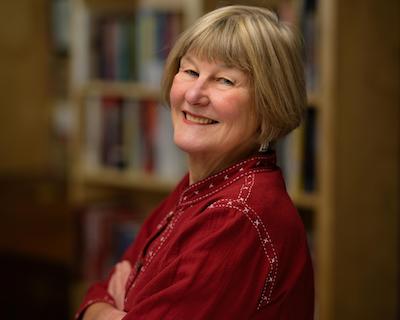
Rosemary J. Brown is a journalist and author based in London.
Her book, Moving Mountains: Intrepid Women Climbers and the Peaks Named in Their Honour, has just been published. Her first book was Following Nellie Bly: Her Record-Breaking Race Around the World (2021).
Rosemary is a Fellow of the Royal Geographical Society, where she helped organize the first Heritage of Women in Exploration conference. She is also a Churchill Fellow and a member of The Alpine Club, The Biographer’s Club, Women in Journalism, and Society of Authors. She received the Antonia Fraser Award from the Society of Authors, and the Audrey Salkeld Bursary for Media and Research into Alpinism from the Alpine Club, for Moving Mountains.
She has written for Harper’s Bazaar, The Washington Post, France Magazine, The Guardian and Inside History, among others.
Rosemary is an avid traveller and a keen climber and has scaled Mount Kilimanjaro, Yala Peak and other mountains around the world.
Talking About Books interviewed Rosemary about her new book and women climbers.
TAB: Your first book was about Nellie Bly, who circumnavigated the world in 1890. What led you to write about women mountaineers?
RJB: Mountaineering is just one of many arenas where women are marginalized and even excluded. Women found freedom in the mountains that was denied to them elsewhere. Their stories reveal how women’s ascent in the mountains paralleled broader struggles for freedom and rights. Like the women in my book, I love mountains, nature and adventure, and I was determined to celebrate their stories. And mountains and summits make powerful metaphors.
TAB: These women are inspirational. You said in an earlier interview that you wanted to put women explorers back on the map, which you have done with this book. How did you choose which women to highlight?
RJB: It wasn’t too difficult to choose because there are not many mountains named after women. That was one of the points I aimed to make with the book. In the end, there were others that I would have loved to include, but I have recorded them in my appendices. More remain to be discovered. However, the book does not advocate naming mountains after people, particularly if they already have Indigenous names.
TAB: You start with Sacajawea, the Shoshone woman who travelled with Lewis and Clarke on their expedition to explore the Louisiana Purchase. She is different from the others in this book: she is not a mountaineer who climbs peak after peak, but more of an explorer. Why did you pick her?
RJB: In writing Moving Mountains, I wanted to celebrate the stories of women across a broad spectrum of time, cultures and nationalities. Sacajawea was chosen exactly because her story is so different from the others. She endured far more than the prejudices and discrimination suffered by all the women in the book. By the time she joined the expedition in 1806, Sacajawea had already endured abduction, trafficking, enslavement, forced marriage and domestic abuse; but her courage, resilience and strength saw her through. She embodies the bravery and steadfastness shown by all the women featured in the book. Today she is honoured across the United States.
TAB: The women in your book defied social convention and expectations about what a woman should be: a wife and mother, and primarily a housewife. What did it take to stand up to society and also to the men who objected to women “encroaching” on their territory?
RJB: You will see in each of the stories, it took courage, determination and self-belief to defy convention and break barriers. Men, and society in general, conspired to keep women off the mountains both metaphorically and physically—by demanding they wore dresses and corsets that put them in danger, excluding them from climbing clubs, and calling their achievements “unwomanly”. The climbers in Moving Mountains stand for the countless women who pushed boundaries, finding freedom in the mountains when it was denied to them elsewhere. It is a hard-won freedom that is challenged even today.
TAB: The women you write about had to face incredible odds, not just the mountains themselves, but also social condemnation for daring to be different. How close are contemporary women mountaineers to being perceived as men’s equals?
RJB: Women mountaineers today are much closer to being seen as equal to men than they were in the past. Women have demonstrated that they can climb the world’s highest and most difficult mountains, set records and take on the same challenges as men. However, there are still fewer women in mountaineering, and they do not get the same recognition, often being marginalized and even excluded. That is another reason why I wrote the book.
TAB: In spite of having peaks named after them, the women in your book are not very well known. Personally, the only two I had heard of were Sacajawea and Gertrude Bell (the latter more for her travels in Arabia). Why do you think that is? Surely later generations would have recognized their importance.
RJB: The history of mountaineering is structured around masculine ideals. It focuses on men’s achievements, while overlooking or ignoring women’s mountaineering accomplishments. It is time the achievements of women climbers are known and their voices heard. As American climber Annie Smith Peck (1850-1935) said, “I have climbed 1,500 feet higher than any man in the United States. Don’t call me a woman mountain climber.”
TAB: In an appendix, you list 85 notable women climbers. That is an impressive number, but compared to men, that is still not a lot. Why do you think that there aren’t more women taking up mountaineering, especially now, without the social stigma attached to women climbers?
RJB: The smaller number of women climbers is not because women are less capable—it is largely the result of historical, social and practical barriers that have limited their participation, including expectations for them to focus on family and motherhood. Because the sport developed around men, women also had fewer female role models and less support. The gap is slowly closing—but mountaineering is still largely male-dominated.
TAB: Is writing something you have always done?
RJB: Yes. Writing has been a life-long passion in my career as a journalist and now also an author. There are messages that I want to get across about expanding horizons and reaching for our own “summits” or goals—whatever they may be. I love that journalism is considered the “first draft of history” and I really enjoy the role of historian that has come with writing my books.
TAB: Thank you for sharing the lives of these amazing women with us.
Read my reviews of Moving Mountains and Following Nellie Bly. You can also read an earlier interview with Rosemary on her book on Nellie Bly.


Pingback: Moving Mountains—Intrepid Women Climbers and the Peaks Named in Their Honour: Rosemary J. Brown – Women's Travel Books
Pingback: Interviews with Writers – Women's Travel Books
It’s interesting to learn more about the inspirations behind a work like this, and both Sacajawea and Nellie Bly are fascinating individuals: I really enjoyed this interview, thank you!
Glad you did! If you haven’t read the books, they are really interesting. And inspirational.