
Translated from Portuguese by Helen Lane
Published by Picador / Alfred A. Knopf, 1989, 663 pages. Original version published in 1984.
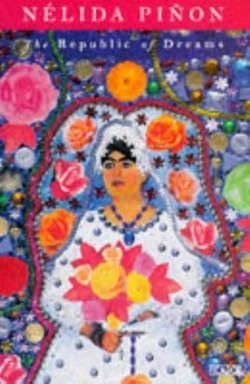
This multigenerational story set mostly in Brazil is centred around Madruga, a Galician who leaves Spain in the early 20th century for the new world in the hope of making his fortune. When the book begins, he is a wealthy and successful man, and the head of a large family. His wife Eulalia has had a premonition of her impending death, so she takes to her bed to start the process of dying (which takes several days).
Madruga wanted to be the first of them to go. He wanted Eulalia to bury and mourn him, not the other way around. He also wants his story to be told, and now that Eulalia does not intend to outlive him, the only person he believes can do this is his granddaughter Breta. As he waits for his wife to die, he goes back to the past and to how it all began, in a little village in Galicia.
As a young boy, Madruga was close to his grandfather Xan, a well-known storyteller. He dreams of someday being able to tell stories the way his grandfather did, and have them handed down through generations. When he is 13, he decides that he will leave the village and go to America (as the entire continent, north and south, was referred to) to make his fortune, in spite of the fact that so many from his village had tried and returned as failures. He has no intention of following in his parents’ footsteps, eking out a living on their farm.
He manages to get money from an uncle and leaves home without telling anyone. On the ship he meets Venâncio, a Spaniard also making his way across the ocean. The two men form a lifelong friendship, with Venâncio becoming an inverse reflection of Madrugo—the opposite of his friend in many ways.
Madrugo uses his brains, sharp head for business, and the gift of the gab to succeed and build an empire, while Venâncio survives on jobs that Madruga finds for him. He rejects the pursuit of wealth that drives Madruga and prefers to wander around the city.
Madruga returns to Galicia to find a bride and marries Eulalia, the daughter of Dom Miguel, an aristocrat. Like Xan, Dom Miguel is a storyteller, drawing on the past and filling his daughter with stories of their family.
Madruga and Eulalia have six children. The two eldest, Miguel and Esperança are close but fight constantly; Bento, the only child to be born in Galicia but who dies on the voyage back; Bento, the child named after his dead brother; Antônia, who never feels as loved as her older sister; and Tobias, who takes after his godfather, Venâncio, and like him, rejects Madruga’s way of life.
Esperança is closest in temperament to her father, and the two clash. He throws her out of the house when he finds out she has a lover. He refuses to have anything more to do with her and is too proud to take her back, although none of his other children fill the gap she leaves behind. Miguel is obsessed with sex; Bento spends his time trying to please his father; Antonia is focused on money and status, having married Luis Filho, part of the Brazilian aristocracy; and Tobias is on his own crusade. Eulalia meanwhile is completely caught up in her religious beliefs and spends more time in church and at prayer than she does with her children. Breta is the only one of the younger generation who is able to get close to her grandfather.
One of the other main characters who is not part of the family but central to it is Eulalia’s maid Odete. Odete was brought over from Africa as a slave and was purchased by Madruga. She is fiercely loyal to her mistress, barely leaving her side. She is the person Eulalia is closest to and the only one she trusts completely. But Odete has her secrets too.
The book follows the family as they go through life. Nélida Piñon interweaves the personal with the larger events in Brazil such as the changing regimes, including a military dictatorship. This moors the novel to a particular time and place.
Madruga, Eulalia and Venâncio might have left Spain but it is still very present within them. All the stories that Madruga and Eulalia have grown up on—Madruga from Grandfather Xan and Eulalia from her father—tie them to their homeland. The civil war in Spain, which results in Franco coming to power, affects them deeply, with Venâncio and Madruga on opposite sides.
There is a stark difference in how the two countries are portrayed, how they are seen by the three Spaniards. Galicia is depicted in muted tones and quiet; Brazil is an explosion of colour and sounds, an entity that is difficult to tame.
Piñon has a distinct style, beautifully rendered into English by Helen Lane. Her sentences sometimes end or begin midway, which gives the language a certain rhythm.
The characters are vividly drawn, especially Madruga, who is larger than life. A man for whom “everything turned into something to fight over. A race for victory. He couldn’t bear failure.” There is a finely observed scene between Luis Filho and Bishop Dom Mariano, who is supporting the rights of workers taking over some of Madruga’s land. Madruga has sent Filho because he would know how to talk to the bishop. The way the conversation unfolds is a delight—the nuances, the things unsaid but implicitly understood.
Ultimately, however, this is a book about dreams, the creation of myths and keeping stories alive. Madruga has no time for dreams—he is too busy making money. That responsibility is Venâncio’s. “If it weren’t for Venâncio”, he tells a partner, “I’d make terrible business deals. He’s my daily ration of dreams. The dreams I don’t have time to dream anymore. Venâncio is now in charge of dreaming in my name.”
This is one man’s desire to leave his story and his legacy to future generations: his struggles, triumphs and heartbreaks, and that of his family. It is a book that you need time to savour. Although there are points where it drags a bit, the book is absorbing because the characters, even the ones who can be annoying, feel very real and you want to know what happens to them. Enjoy it.


This sounds so rich, so rewarding. I’m particularly intrigued by how you’ve described how he presents the two locales. Thanks for bringing it to my attention! (And what a long read, so I suppose one must expect a few moments where it’s a little less gripping.)
The novel takes its time telling the story, and it does drag a bit at times. But the characters draw you in. She has a very distinctive writing style.