
Translated from French by Walter J. Cobb
Published by Penguin, 1964 (this translation), 501 pages. Original version published in 1831.
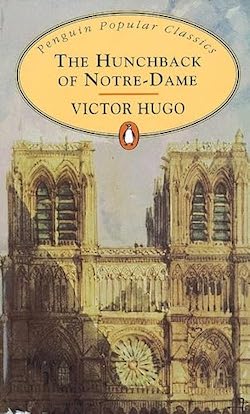
What makes a monster? Quasimodo, the bell ringer of Notre Dame, is physically deformed: he has a humpback, a protrusion on his chest, and only one eye because the other is covered by a wart. As a child, he was left in the foundlings’ bed, and no one wanted him until the priest Claude Frollo took him in.
Quasimodo is completely devoted to Frollo, the only person who has ever shown him any kindness. People are cruel to him because of the way he looks, so he returns the favour. His devotion to Frollo is matched by his love of the bells of Notre Dame. He has names for all of them, and it is when he is up in the tower, ringing the bells, that he is truly happy.
When the book starts, it is the Feast of Fools, an annual event that mocks ecclesiastical rituals. Quasimodo is elected Pope of the Fools but is later attacked by an angry mob. Esmeralda, a lovely young gypsy, offers him a drink of water, and he falls in love with her.
But his foster father and now Archdeacon Frollo is obsessed with Esmeralda and stalks her. He gets Quasimodo to kidnap her, but his attempt is foiled by Captain Phoebus de Châteaupers, a dashing young officer. Esmeralda falls in love with Phoebus, who tries to seduce her and lures her to a room he has rented. Frollo, who has been following Esmeralda, sees this, and stabs Phoebus in a jealous rage. Then he escapes, leaving Esmeralda to take the blame for the stabbing. (So much for his love!)
Phoebus is left for dead, and Esmeralda is arrested for his murder. He survives, but keeps a low profile. He is focused on his upcoming marriage and doesn’t really care if Esmeralda is hanged for his murder. She was only a passing fancy anyway, a woman he declared his love for so that he could get her into bed.
Esmeralda, who is about to be hanged, is rescued by the community of beggars and the Roma she travels with, and hides in Notre Dame, where Quasimodo takes care of her. These two have a link that neither of them is aware of: as a child, Esmeralda was stolen from her mother, a prostitute, and replaced with Quasimodo. Her mother was distraught and never got over her loss. Esmeralda, meanwhile, has been looking for her birth mother.
Meanwhile, Frollo, who finally understands that Esmeralda won’t have anything to do with him—she finds him repulsive—decides that if he cannot have her, no one else will. Things come to a head when Quasimodo realizes that Frollo is a danger to Esmeralda. He has to choose between the two: will he take on his foster father to protect the 16-year-old girl?
This is a short version of a long and complicated story, set in Paris in 1482. Victor Hugo wrote the book in 1830, a time when old buildings in Paris, including Gothic churches, were under threat, being demolished to make way for the new. Hugo wrote this book to show Notre Dame in its heyday, as a plea for preserving it. His descriptions of the cathedral—“a vast symphony in stone”—are extremely visual (it reminded me of his description of the Paris sewers in Les Misérables). The cathedral is very much the centre of the book. Hugo’s attempt to save it worked because Notre Dame has since become a national icon.
One of the threads in the story is the way the “other” is perceived. Quasimodo is mistreated, mistrusted and seen as a monster because he is physically deformed. Esmeralda is accused of witchcraft and other crimes, simply because she is a gypsy. But the real monsters in this story are Phoebus and Frollo: nasty, self-centred and creepy. With men like these around her, a young naïve girl like Esmeralda doesn’t stand a chance. The only real kindness and loyalty she gets is from the deformed bell ringer, the so-called monster.
Hugo’s descriptions of people are vivid: Quasimodo’s expression—“a mixture of malice, astonishment, and sadness”; Frollo’s “austere, icy exterior” that hid strong passions like “lava, deep, boiling, furious”.
There is humour here too—Quasimodo is arrested for attempting to kidnap Esmeralda, and the trial is a farce. The judge is deaf but pretends he isn’t. The trouble is that Quasimodo is also deaf. The judge questions Quasimodo, but as Quasimodo cannot hear, he does not answer the judge. The judge, thinking he has, continues on to the next question.
One of my gripes about the book is the frequent use of Latin phrases. Even if it was understandable to the reading public at the time, it gets in the way of the flow of the story.
The book took me a while to get into: the first chapter, set during the Feast of the Fools, tends to go on for a while, and I kept waiting for the real story to begin. Once it did get going, it pulled me in. The end is fairly melodramatic, but I couldn’t stop turning the pages!
The next time I go to Notre Dame, I will think of Quasimodo and the other characters, who have now become an integral part of the cathedral for me.


Pingback: Les Misérables: Victor Hugo – Talking About Books
Overall, I’ve not read many of the French classics, but in theory there are quite a few I’d like to try/read, including this one. Your comment about the melodrama rings true (look, a bell joke heh) with other things I’ve heard, and Hugo doesn’t strike me as a writer who’d get quickly to his point. What made you finally pull this one into your stack?
It’s been sitting on our shelves for a long time. I was taking the train to Paris, so it seemed like an appropriate read to take along. I think I prefer Les Misérables, even though it is a lot longer. I would recommend The Count of Monte Cristo. Rollicking read!