
Published by Zaffre, 2023, 280 pages
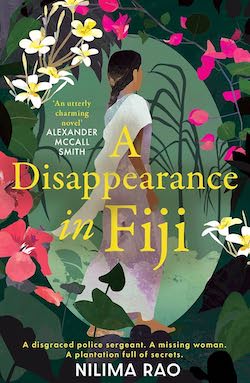
Fiji, 1914. Sergeant Akal Singh, an Indian Sikh, has been sent to Fiji after a humiliating incident in Hong Kong, where he was serving. All he wants to do is crack an important case to prove himself, so his superiors can send him back to Hong Kong.
When his Inspector-General asks him to investigate the disappearance of a missing indentured woman from a sugarcane plantation, he makes it clear that it is merely a formality. The reason Akal is sent to investigate is that a priest, Father Hughes, has gone to the newspapers, saying that the woman Kunte did not run away—as is commonly assumed—but has been kidnapped. The plantation’s overseer left to fight in World War I and the assumption is that he took Kunte with him. Akal’s job is to merely show that the police are taking Father Hughes’s accusation seriously.
Fiji’s viability as an English colony depends on sugarcane, so it is best not to create problems for the plantation owners. The governor of Fiji decreed that no Fijians were to work on the plantations, so over 60,000 Indians were brought over as indentured labourers, often under false pretences. Once at the plantation, they had to work a number of days so that they could be free of their contract, but it was entirely up to the owner and his overseer to decide which days counted.
Akal rides into the country with Dr. Robert Holmes, who is going to the plantation to tend to the coolies, as the Indian labourers were referred to. The plantation is owned by Henry Parker, whose wife Susan lives in the capital Suva and has ambitions for Henry to become the head of the Planters’ Association. A position that in reality, she will fill, from behind the scenes.
Henry is not too happy to have an Indian police officer staying at the plantation and tells him to stay in the accommodation provided to the Indians—tiny rooms with no amenities. But when Robert insists that if Akal is staying in the coolie lines, so will he, Henry lets them both stay in the overseer’s cottage.
As Akal talks to the Indian labourers and to people in the nearby town, he begins to realize that there is far more to Kunte’s disappearance than he had thought. He and Robert join forces to investigate, and they uncover the secrets and lies that the plantation hides.
This is an interesting look at Fiji during the Raj and the power dynamics in the country. Akal is, in a sense, an outsider, but all too often conflated with the other Indian labourers because of his nationality. Nilima Rao writes about the conditions on the plantations, which were appalling. Poor Indians, who could barely read, signed papers promising them a good job, and were brought to plantations where they were housed in insalubrious conditions and made to work long hours with very little pay. Except for the promise that someday, they might be able to be free of their contract. In the meantime, the women were preyed on by the British men overseeing the plantation.
Rao immerses you in the period. Every chapter starts with an excerpt from a column in the Fiji Times published at the time, written by someone called Chop Chop, who skewers the system and especially the way women labourers were treated.
Rao’s ancestors came to Fiji as indentured labourers, so this story is clearly close to her heart. It works as a crime novel, but like all good crime novels, is revealing about the time and place it is set in.
I look forward to reading more in this series!


Pingback: Focusing on Fiji: An Interview with Nilima Rao – Talking About Books