
Published by Algonquin Books of Chapel Hill, 2021, 302 pages
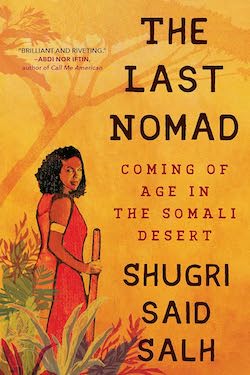
“I am the last nomad. … What I am really trying to say is, I am the last person in my direct line to have once lived like that, and now I feel like the sole keeper of my family’s stories.”
Shugri Said Salh’s family was nomadic, in the desert of East Africa. Her father left the nomadic life as a teenager, travelling from Somalia to Ethiopia for an education. Her mother left the desert when she married and moved to the city, but found it harder to let go of her nomadic ties. Her own mother needed a helper, and so she sent Shugri, still a young child, to the desert.
Salh loves her new life. She is treated like an adult, with responsibilities and a bit of freedom. As a four- or five-year-old, she is responsible for taking care of her grandmother’s baby goats. At six, she graduates to tending a herd of older goats. She keeps watch for predators by climbing onto termite mounds or trees. She loves the desert and adores her grandmother, her ayeeyo—a strong woman, a widow who does everything herself, without needing to rely on men. Salh learns to navigate her way in the desert by remembering landmarks, which she credits for her ingrained sense of direction as an adult.
Salh writes about the hard life of the desert—the dry season, known as jilal, when the tribe has to walk miles to find water, and people and animals both become severely dehydrated. This is followed by the season of plenty, gu, when the rains come.
“During the time of gu, it was as if we had a sacred reprieve, a time for rejuvenation, which we appreciated even more because we knew that jilal would come again and the red desert would turn ominous once more.”
There is a harrowing moment when Salh, now aged eight, undergoes female genital mutilation, a custom in her tribe to keep girls “clean”. She does not question the need for this—she is, after all, a child—and it is only when she is an adult, married and living in the United States that she truly understands the enormity of what was done to her.
Salh is nine when she leaves the desert for school. It is a time of learning, making friends and growing up.
When civil unrest starts to sweep through Somalia, Salh is a teenager living with her married older sister. They are forced to flee by land to Kenya, following on to Canada to live with her oldest sister and then to the United States.
Her life has been a journey, from a nomadic life in the desert to an American city, a contrast she brings out when writing about the differences between her own childhood and that of her children. She wants them to hold onto their heritage, and so she tells them stories about her life.
This is a story of strength and resilience. It is also about a completely different way of life, and about Somalia, systematically portrayed as “war-ridden” by the media. But the Somalis are also poets. It is, writes Salh, “the nation of poets, creating poems is considered a sign of intelligence in our culture. Generations of Somalis committed countless poems to memory and repeated them to their children, creating an enduring legacy. During my ayeeyo’s time, poetry was a major form of communication among the nomads.”
This is the point of telling stories: introducing faraway readers to a way of living and culture that they would not otherwise know. Salh writes vividly with a lot of heart about her country, both its joys and its sorrows. This is a book I would recommend.
Read the Talking About Books interview with Shugri Said Salh.
This review first appeared on Women on the Road.


Pingback: Growing Up in the Somali Desert: An Interview with Shugri Said Salh – Talking About Books