
Translated from Tamil by N. Kalyan Raman
Published by Eka (Westland Books), 2018, 173 pages. Original version published in 2017.
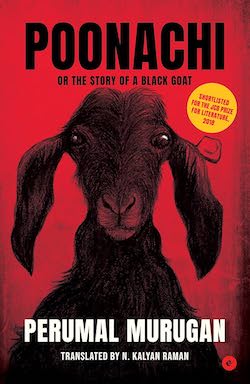
“Once, in a village, there was a goat. No one knew where she was born. The birth of an ordinary life never leaves a trace, does it?”
Near a village in Tamil Nadu, an old man sits, thinking about how the rains had been sparse that year. It is dusk, and the shadows are lengthening. In the distance, he sees a figure approach—a big man, almost a giant. He is not someone the old man knows, and he knows everyone in the region.
The giant approaches the old man and tells him he has been trying to sell a day-old kid, the seventh in a litter. Goats normally give birth to two or three kids at a time, so the old man is sceptical. The stranger hands over the kid to the old man and walks away.
The kid is completely black and tiny, small as a kitten. The old man puts her in a basket with grass to take her home. On the way, an eagle tries to snatch the little goat but fortunately, it misses, and the goat is safe.
The couple have goats of their own, and one has just given birth. The wife tries to get the new kid to suckle with the others, but the mother goat rejects her. The old woman is determined that the kid will survive and finds ways of feeding her. She calls her Poonachi.
The problem now is that they have to report Poonachi’s birth to the authorities. The state keeps records of all livestock—each birth is entered into a register with the parentage. Then the ear of the animal is pierced and a numbered tag inserted. How are they going to report Poonachi? They don’t know anything about her. They finally pass her off as part of the litter of the goat who had just given birth.
This book follows Poonachi as she grows, fights to survive, and has kids of her own. She observes the world around her, trying to understand why humans behave as they do. On a trip to the couple’s married daughter, she meets a ram, and they fall in love. But she is dragged away and taken home, and mated with an old ram.
Poonachi is seen as a miracle goat—when she has her kids, there are seven in the litter. All of them are sold, and she does not see them grow up. She sees her fellow goats killed either for food or as sacrifice.
This is a fable for adults—it is a simple book but there is nothing childlike or simplistic about it. Poonachi is a sentient creature, one with a character and opinions of her own. She has no agency over her life: it all depends on the humans who raise her. In a way, her condition reflects the condition of women.
But the humans in this case—the old man and woman—are not free either. In the background looms the state: a controlling, rather malevolent power, that dictates how they live their lives and monitors everything. “Everyone was well versed in how they were expected to behave towards the regime. They had mouths only to keep shut, hands only to make obeisance, knees only to bend and kneel, backs only to bend, and bodies only to shrink before the authorities.”
Perumal Murugan writes about the disenfranchised, those without a voice, as he does in this book, although the protagonist is a goat.
Poonachi goes through emotions that reflect our own. Her reaction to the way goats and sheep are treated is very human. Goats tend to wander, so they have to be shackled with their forelegs bound to their necks, unlike sheep. Proud goats were forced to look at the ground as they walked. “Goats always tried to break free of their shackles”, Poonachi muses. “Sheep had none… If it was in your nature to bow down, why would anyone shackle you? And yet, they were fortunate, these sheep. They had no inkling that to bow was to be shackled.”
In his translator’s note, N. Kalyan Raman writes, “Through his exploration of the life journey of an animal, Murugan leads us deep into ‘an intimate history of humanity’ and the irreducible human essence that we must fight to preserve.” He compares Poonachi to George Orwell’s Animal Farm and Mikhail Bulgakov’s Heart of a Dog: all intensely political books with animals as protagonists.
Through the life of this goat, Murugan relates a moving story about the human condition.

