
Published by Head of Zeus, 2022, 276 pages
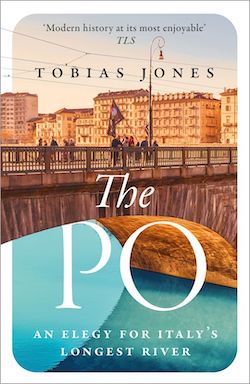
“You need to understand the Po to understand Italy”, wrote the poet Guido Ceronetti. So Tobias Jones sets out to explore the river, going against its current: he starts from where it flows into the Adriatic Sea, tracing it back to its source in the Alps.
Compared to some of the world’s great rivers, the Po is small. But it is not insignificant. It has 141 tributaries, a drainage basin of 71,057 square kilometres—a quarter of all Italy—and 20 million inhabitants.
Jones travels by any means that seem appropriate: by foot, bicycle, boat, car, bus and train. He does not stay on one side of the river, but crosses over when he finds something interesting on the other side. The Po has changed course over the years, so as he delves into the history surrounding the river, he sometimes moves away from it, following its ancient course. Which makes for an interesting journey.
The river is full of history. It has been a highway and thoroughfare, used to transport goods. Duchies and principalities have fought for access to the river so that they could levy taxes on goods. The river also acted as a moat, stopping invaders from the north crossing over to the south. And it has provided shelter for the dispossessed and the excluded.
The book begins in the delta where the Po flows into the Adriatic: neither sea nor land, “a spacious maze of low-lying bars, islands and spits. All is flat. The sky is wide and the distant land is nothing more than blue-grey mould on the water. … It’s no longer a place where humans belong.” It belongs to the birds and the fishes.
That is not what the rest of the Po is like. Humans are very much present. Those from the past have left behind castles and monuments. But the real damage has occurred over the last century: not only has it been dammed, but the gravel and sand of its bed has been used during Italy’s “economic miracle” boom years. Native species, wildlife and plants, have been pushed out by invasive ones. Some of the river has been drained, and its water used for agriculture. Not to mention the pollution: sewage flows into it, as well as heavy metals, phosphates, microplastics and much more.
The book is not all doom and gloom, though. Jones speaks Italian—he has lived in Italy for many years—so he has no trouble talking to the people. Near Zibello in Emilia Romagna, he goes to a farm in search of eggs. The people seem surly and unfriendly at first, but open up when he starts talking to them. The daughter brings him eggs gathered in her jumper: they have no egg boxes. The farmer suggests that the only way to carry them is “in your stomach”! So Jones cadges an onion from them, and cooks the eggs on a bank near their farmstead.
Jones takes us on a journey through time: the battles going back centuries, such as the Lombardy wars fought between the Venetian Republic and the Duchy of Milan in the 1400s; the partisans who were killed in 1945; and Giovannino Guareschi, the author of the Don Camillo books, which were my first introduction to the Po, when I read them as a young teenager. They are about Don Camillo, a Catholic priest, and his adversary, Peppone, the Communist mayor. The “pacifying presence” of the river is very central to these books.
As he approaches the Po’s source, the river and its surroundings become a little less built up. Going past Cremona, he is “dwarfed by its heavy industry: the oil refinery and steelworks. Then, suddenly, you’re lost in the woodlands along the water, and it’s as if you’ve covered a few centuries in the space of five minutes. The sky is clear and for the first time on this journey I can see, to the north-west, the creamy peaks of the distant Alps.”
I enjoyed Jones’s writing: the “rowdy silence” of Luzzara, a village with streets named after the partisan martyrs of 1945, a silence that is filled with voices from the past, and the Po, the “silent stalker” which glides past the village quietly, “like a bully, always ready to rise up”. His description of the delta: the great distances making it feel “like you’re on infinite tin foil, glinting and crackling”.
If you’re looking for an uplifting book about a trek down (or up) a river, this is not it. The damage people have done to the river is horrifying (something that is happening to rivers around the world, not just in Italy). I’m glad Jones decided to go from the end of the river to its source and not the other way around—it makes for a less depressing read. But he finds so much richness along the way, in the people he meets and the landscapes he passes through.
The Po combines travel, history and ecology. Jones brings Italy’s history—and its present—to life. When I finished it, I felt that I had learned a lot about the country from this one book.

