
Translated from Italian by William Weaver
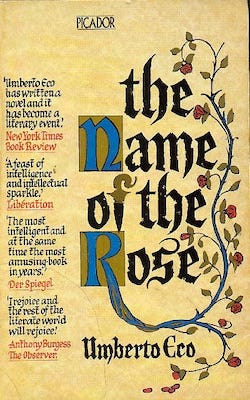
Published by Picador / Vintage / HarperVia, 1983, 502 pages. Original version published in 1980.
“Now I realized that not infrequently books speak of books: it is as if they spoke among themselves. In the light of this reflection, the library seemed all the more disturbing to me. It was then the place of a long, centuries-old murmuring, an imperceptible dialogue between one parchment and another, a living thing, a receptacle of powers not to be ruled by a human mind, a treasure of secrets emanated by many minds, surviving the death of those who had produced them or had been their conveyors.”
1327, a Benedictine abbey in Italy. A Franciscan monk, William of Baskerville, and a novice, Adso of Melk, are at the abbey for a theological disputation. They are greeted by the abbot, who asks William to look into the death of Adelmo, a monk at the abbey.
The next day, another monk is found dead. There are more deaths, each of the bodies found with a blackened tongue. Who is killing these monks and why?
Despite this brief summary, The Name of the Rose is much more than a murder mystery. Umberto Eco set the story in 1327, during a time of tumult in the Catholic Church. Pope John XXII was an Avignon pope—from 1309 to 1376, Popes lived in Avignon rather than the Vatican, a situation that arose because of the conflict between the papacy and the French crown. Pope John XXII opposed the Emperor Louis IV, also known as the Holy Roman Emperor, who had set up another Pope.
To add to this, there was an ongoing debate about whether Christ owned anything—in other words, was he poor, and if he was, should the Church not follow his example and give up its riches? Pope John XXII denounced many of the followers of this belief as heretics. Among these was Fra Dolcino, a radical reformer who believed in Christ’s poverty and was prepared to go to any lengths for his beliefs, including looting and killing. He was captured and killed, and many of his followers were burned at the stake. This, after all, was the time of the Inquisition. However, it seems that a couple of his followers have ended up at the abbey.
The debate on Christ’s poverty is why William of Baskerville is at the abbey. The abbot is hosting a debate between the two factions in an attempt to bring them together. William is there as a representative of the Emperor. One of the men attending the debate is Bernardo Gui, a papal inquisitor. The murders at the abbey play into his hands—if William does not find the murderer by the time Gui arrives, the abbot will have to hand over his powers to the inquisitor. And he is not going to look for the truth, but instead focus on finding signs of the devil’s work.
The dead monks all have a connection to the library, a vast repository of books and scrolls, some of them very valuable. Scholars cannot access the library, which is a labyrinth that only the librarian and his assistant can enter. Scholars can only look through the catalogue and request the librarian for a book, and if he thinks their request is problematic, he takes it to the abbot.
William is convinced that the secret to the murders lies in a book hidden in the abbey’s collection. He and Adso manage to get into the library after everyone has gone to bed, and little by little, they put the pieces together.
The book is narrated by Adso, now an old man, looking back. He remembers a young girl from the village to whom he lost his virginity and whom he fell in love with. Eco captures the feeling of young love, the way the world suddenly comes into focus because everything reminds him of her. “This was the only earthly love of my life, and I could not, then or ever after, call that love by name.” The girl was later accused by Gui as being a witch, an example of the poor and innocent being caught up in the web of the powerful.
I read this book decades ago and was more focused on the whodunnit part of it to enjoy the rest. But having read it and seen Jean-Jacques Annaud’s film a few times, I now know whodunnit and why, so I could savour Eco’s detailed descriptions, not just of the theological discussions and the debates about laughter, but also of the building itself. The figures that he describes carved on the door to the abbey’s church—which make such an impression on young Adso—reminded me of the panel on Hell in Hieronymus Bosch’s Garden of Earthly Delights. I enjoyed some of these lengthy descriptions, but there are times when Eco gets carried away—Adso’s dream towards the end of the book is one that comes to mind—and I wished he would just get on with the story.
That said, there is a lot to appreciate here. The way William and Adso break the code of the library, figuring out how it is organized is a nerd’s delight—and there is a diagram explaining it too.
Among the main themes of the book are knowledge, and the power of laughter and comedy. One of the murdered monks was a scribe who used ridiculous images in illuminating his manuscripts. Laughter is something the old blind monk Jorge de Burgos rails against because he sees it as a desecration of faith, of religion. His greatest fear is that comedy will be taken seriously, and once that happens, it will upend society and bring chaos. Therefore, anything—especially books—that pertain to comedy should be seen as dangerous.
This book is also a warning against unquestioning and rigid beliefs. “Fear prophets, Adso”, warns William, “and those prepared to die for the truth, for as a rule they make many others die with them, often before them, at times instead of them. … [T]he only truth lies in learning to free ourselves from insane passion for the truth.”
This is a novel about the power of knowledge and of the written word. Although it can sometimes be a bit long and convoluted, it was definitely a book I could get my teeth into. I enjoyed rediscovering it all these years later.


I, too, love rereading, and noticing what different elements stand out, at different times. I’m sure I’d’ve been caught up in the mystery elements on a first reading too!
This is a book worth reading twice—unless, maybe, if you’ve seen the film, which is pretty good.