
Translated from French by Helen Stevenson
Published by Serpent’s Tail, 2025, 207 pages. Original version published in 2022.
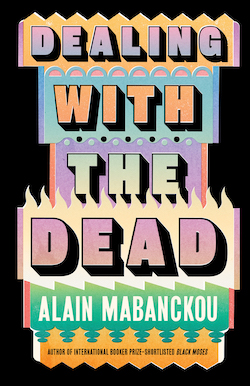
“Once you’ve been laid in the earth, time will start to do its work, and for all their good intentions, the people who knew you will gradually forget, till one dry season comes when not a soul ventures forth to your tomb. Weeds will stifle it, lizards will haunt it, and black snakes too—those ‘souls of no fixed abode’, who, according to your native Babembé legends, caused such harm when they were alive that in death they are turned forever into reptiles of the grave…”
But before that happens, there is a story to be told.
Liwa Ekimakingaï wakes up to find that he is dead, lying on his grave in the cemetery of Frère-Lachaise in his hometown of Ponte-Noir in the Congo. He is wearing an orange crêpe jacket, fluorescent green shirt, white bow tie, purple flares and red Salamander shoes with white laces.
It takes a little time before Liwa can adjust to his new status. He is 24 years old and when he was alive, he lived with his beloved grandmother Mâ Lembé. He must try to remember what happened to him and find the people responsible for his death.
He dreams “the longest dream” of his death, a dream that takes him to his grandmother’s home where a four-day funeral is taking place, with women dancers and crowds of people. The only face he really wants to see is his grandmother’s but she has her back to him. He remembers his life, how his mother Albertine died when he was a child, and how he was raised by Mâ Lembé.
When he wakes up from his dream, he meets some of the denizens of the graveyard and hears their stories. Prosper Milandou, who was the Director of Human Resources at the Lyon Water Board in France and moved back to the Congo to take up a job at the Congo National Electricity Board. Lully Madeira, a musician who made a pact with the spirits in return for fame, until he went too far. Black Mamba, the keeper of Frère-Lachaise when he was alive, and who now watches over the ghosts. And Liliane Bilongo, the “Crow Woman”, who tried to expose paedophiles—some of them in positions of power—and fell foul of them. The most moving story is about the dead twins, whose mother visits their graves and takes care not to step on a single ant, so as not to crush a single life.
Although Liwa has been warned by the ghosts not to seek revenge, and instead to do one act of kindness, he has made up his mind to seek out his killers. It is on this journey that you learn about what really happened to him.
There are some shocking stories—men in positions of power with an unquenchable greed who will stop at nothing to get what they want—but there is also humour. Take the cemetery Frère-Lachaise. The President, Papa Mokonzi Ayé alias Zarathrustra, wanted a graveyard that would be a replica of the Parisian one, Père-Lachaise, where the well-to-do of Pointe-Noire would be buried. But the poor stole a march on him by calling their cemetery Frère-Lachaise, so the wealthy were now buried in the aptly named Cemetery of the Rich.
This is an enjoyable read—unusual, funny and moving. Through the stories of the dead—and Liwa’s own story—Alain Mabanckou exposes the corruption and greed in the high echelons of the Congo, as well as the ties that bind us to those we love.
Although the book is largely about the dead, it is exuberant and full of life, as bright as the clothes Liwa is buried in. A real delight.
Read the review of Alain Mabanckou’s memoir, The Lights of Pointe-Noire.


I have his name jotted down in my notebook, but I can’t recall if this was one of the novels available here or not (not in my local library, but via ILL).
The way you’ve described his style, particularly the unexpected humour, makes me think of GauZ’ who is a Franco-Ivorian writer; if you don’t know his writing, I bet you would enjoy it (also originally written in French, two currently available in English translation, one of those by Frank Wynne, whose name I think I’ve spotted elsewhere on your site).
Thanks, Marcie. Will loook out for GauZ’s books. I enjoy Alain Mabanckou’s writing. Am just adding a link to the other book of his reviewed on this site—a memoir this time.
Pingback: The Lights of Pointe-Noire: Alain Mabanckou – Talking About Books