
Translated from Portuguese by Margaret Jull Costa
Published by The Harvill Press, 2004, 292 pages. Original version published in 2002.
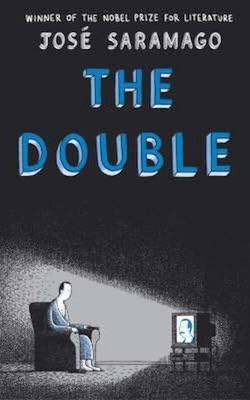
Tertuliano Máximo Afonso, a history teacher, is depressed. His colleague, the Mathematics Teacher (never named), suggests he watch a light video to cheer himself up. The video he recommends is one made five years ago called The Race is to the Swift.
Tertuliano watches it that night and decides it is a waste of time. But in the middle of the night, he wakes up, feeling that someone is in his apartment. There is no one there, but he gets the distinct impression of a presence. Maybe it’s something he has seen in the film? So he plays the film again, and there it is. The actor playing the hotel receptionist looks exactly like Tertuliano, down to the thin moustache he used to wear five years ago.
Tertuliano becomes obsessed with finding the actor. He tells no one, and goes through elaborate schemes to find the actor’s name. This means watching all the films made by the production company that produced The Race is to the Swift, and going through the list of actors, looking for his double. He finally finds the man’s name: Daniel Santa-Clara. His real name is Antonio Cláro.
He tracks him down, dragging his girlfriend, Maria da Paz, into it. He persuades her to write to the production company for Antonio’s address. He doesn’t tell her the truth, merely that it is related to some research he is carrying out. The production company, surprisingly, obliges, and it is only a matter of time before the two men meet.
They are identical in every way, including the moles on their arms and the scars on their knees. Tertuliano eventually tells his mother, who warns him that nothing good can come of their meeting. It is clear that the two men are not twins: Tertuliano’s mother had no idea that Antonio existed.
Is it possible to live with the knowledge that somewhere in your city, a man is walking around with your face, your voice? If he exists, then who are you? Is one the original and the other a copy? What does it mean when a wife cannot tell the difference between the two? And more important, can two identical people co-exist, or has one to die so the other can live? None of these questions mattered before the discovery, but with the awareness that each has a double, these questions become all-consuming. The knowledge destabilizes the men, and things escalate.
Getting used to Saramago’s style takes time—long run-on sentences, digressions and repetions, and dialogues with only commas separating the lines of the speakers until sometimes it is hard to remember who is speaking. The only punctuation he uses are commas and periods. The result feels like stream of consciousness—you get into Tertuliano’s head, following his thoughts, and you are witness to the obsession that seems to take over his life. Saramago’s books often put the protagonist into surreal situations, and this is no exception.
The end is a bit over-the-top, but this is a strange, compelling book, which looks at how central individuality is to us, and how we can unravel when it is taken away.


This sounds very interesting, and the character’s sense of there being someone in the room with him has an interesting political layer to it too. Also, I know what you mean about his style; I have Blindness on my shelf and that’s exactly what it looks like, a whole bank of prose, so I must choose the proper reading mood.
Yes, Saramago’s style takes a little getting used to. I have Blindness on my shelf too, and haven’t got around to it. The Double was interesting and quite layered.