
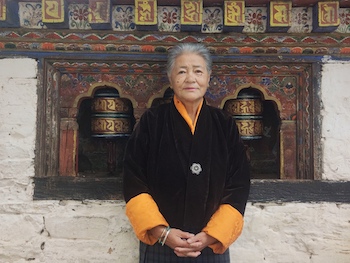
Kunzang Choden is a Bhutanese writer.
Her books include the first novel in English to be written by a Bhutanese woman, The Circle of Karma (2005); her memoirs, Telling Me My Stories (2025); Membar Tsho: The Flaming Lake (2012); Tales in Colour and Other Stories (2009); Chilli and Cheese: Food and Society in Bhutan (2008); Dawa: The Story of a Stray Dog in Bhutan (2004); Bhutanese Tales of the Yeti (1997); and Folktales of Bhutan (1994).
With her family, Kunzang runs a civil society organization named after her ancestral home, the Ogyen Choling Foundation. The foundation promotes Bhutanese historical and cultural heritage and works for the well-being of the community. She also founded Riyang Books, a publishing house, with her family.
Talking About Books interviewed Kunzang on the changes that have taken place in Bhutan, her childhood and the importance of folktales.
TAB: You were born into a feudal society, but one that was modernizing. You must have seen a lot of changes in your lifetime. Could you tell us about some of these changes?
KC: Yes, I have seen much change in my life. In my earliest memory, I recall myself as a girl growing up in a privileged household. Then changes came into our lives, altering everything around us and about us at the individual level. These changes were brought on by Bhutan’s decision to move out of an insular medieval feudalistic-like situation to embrace modernization. So, in a way the changes that may have taken modern industrialized countries more than hundreds of years, were, in Bhutan, compressed into a few decades. New social and political systems were introduced. Modern schools were built, motorable roads were constructed. Children who were herding cattle and collecting firewood were encouraged to go to schools, and people who had until now travelled on foot could now travel in vehicles, health facilities were built, and communication systems were set up.
TAB: In your memoir, you write vividly about your childhood. The descriptions made me feel as if I was there. How are you able to recall your childhood so perfectly?
KC: In the initial years of my boarding school life in India, when I could still not communicate nor relate to the new environment and the new culture, and was lonely, I repeatedly but quietly relived my childhood in my home for reassurance and solace. My memories came to me vividly and in great detail. Perhaps the intensity of my memories was because I had only nine precious years with my parents before I left for school in India. Both my parents died within the three years of my life away from them.
TAB: You were sent away to India to study when you were still young, and initially found it hard to adjust to a culture so unlike yours. How did that change you? How did you feel when you returned to Bhutan?
KC: From having lived within the physical boundaries of the area where my home was located, I had no idea of what lay beyond these boundaries. The excitement of going beyond these boundaries was soon overpowered by bewilderment, alienation and culture shock, and a total loss of self-confidence. With hindsight, I think we should have been briefed a little bit in preparation for the new country we were travelling to, as well as some information on the schools we were being sent to and on what we could expect. Just the knowledge that we were going to India for a foreign education did not prepare me at all for the overpoweringly unfamiliar world that I was thrust into. When I returned to Bhutan, I could gradually understand and accept the changes, but memories of what life was before the changes stuck with me.
TAB: The monarchy is still central to Bhutan, although the country is now democratic. It is also a mix of the traditional and the modern. How do these—monarchy and democracy, tradition and progress—co-exist in modern Bhutan?
KC: Monarchy is just over a hundred years old. The first king was elected by the political civil and monastic leaders and peoples’ representative in 1907. The general experience of the people under monarchy has been a positive one. The changes brought about by the monarchy have been beneficial to the welfare of the people. The transition to democracy was initiated by the monarchy in 2008. Since then, there has been a smooth progression to adaptation and adjustment to new perceptions and expectations. The progression has been guided by the country’s traditional values while at the same time embracing modernity. A natural mix of the two has its challenges, but we are flexible as we are resilient, and Bhutan has largely managed to maintain its character and identity as a peaceful Buddhist nation.
TAB: In The Circle of Karma, you write about the life of a woman from a Bhutanese village. In Tales in Colour and Other Stories, you also write about Bhutanese women from rural areas. Why did you choose to tell their stories?
KC: I chose to write about rural women to give a voice to those who were not heard nor empowered by education, exposure and mobility.
TAB: What struck me about the story of Pema Tsomo in The Circle of Karma were some of the freedoms that were allowed women. For example, formal marriages are not a way of life in rural Bhutan, and virginity is not as important as it is in some other Asian cultures. But on the other hand, Tsomo’s father denies her an education. Is there gender discrimination in Bhutan? How has it changed since you wrote the book?
KC: Yes, unlike the conditions that our sisters in South Asian cultures endure regarding marital freedom and sexuality, Bhutanese women were generally not constrained by societal norms and expectations. We had, comparatively speaking, freedom of choice. In the case of Tsomo, at the time she was growing up and yearning for religion, education was still seen as being synonymous with religion, which was then in the realm of men who received religious education in the monastic institutions. Women were not encouraged to abandon their homes to go into religious institutions. In a practical layman’s view, women were needed in the homes to keep the farming activities going on, so as to sustain economic life. Of course, there was a general gender bias in access to education.
In the initial phase of education for all, there was a general reluctance to send girls to school because we had no history of girls being educated. Since the introduction of modern education beginning from the 1960s, enrolment of both boys and girls into schools has been encouraged, and education is free for all up to grade X. Tertiary education is competitive and merit based. Today, Bhutan’s literacy rate is 70.6 percent and has achieved near total gender parity.
TAB: You have compiled several collections of Bhutanese folk tales. I believe that this is the first time these stories were recorded in English. Why was it important to do this? Why are folk tales important to culture?
KC: Until the 1960s, Bhutan was largely an oral society. Literacy was confined to the elite and the clergy. The rest of the society thrived on oral tradition. Most of the religious texts dealt with religion, be they scriptures, biographies, rituals, and so on, with little or no reference to the common people. The common folk created and passed on their histories, songs, sayings, their understanding and their values and morals orally. With the introduction of education, there was a danger that the oral tradition would lose its importance. I spent the first part of my life in an oral society which had a lasting impression on me, and I wanted to record the stories of my childhood to pass them on as my cultural legacy to the generations to come. I wrote in English because my entire education was in English-medium institutes of education.
TAB: Could you comment on contemporary writing in Bhutan?
KC: Within just a short few decades of education and literacy, Bhutanese writers have managed to form quite a remarkable collection of contemporary works. These include academic as well as literary works, including children’s literature.
TAB: When did you start writing? Is it something you’ve always done?
KC: I always liked writing but I began writing seriously when I stared to record the oral stories I had heard in my childhood for my own children. My book of folktales was published in 1996.
TAB: Thank you for the interview and for sharing your insights on Bhutan and Bhutanese culture.
Read my reviews of Kunzang Choden’s Telling Me My Stories and The Circle of Karma.


Pingback: Telling Me My Stories—Fragments of a Himalayan Childhood: Kunzang Choden – Talking About Books
Pingback: The Circle of Karma: Kunzang Choden – Talking About Books
Fascinating: thank you for sharing this. It looks like I may be able to find a copy of The Circle of Karma, so I look forward to that.
Thanks! I’m glad you can find The Circle of Karma, Marcie. I think it is also available on Kindle, if I’m not mistaken. I loved it.