
Translated from Japanese by Polly Barton
Published by 4th Estate / Ecco, 2024, 452 pages. Original version published in 2017.
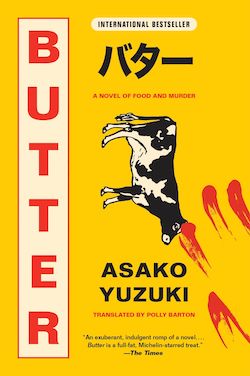
Rika Machida is an ambitious journalist working at the Shūmei Weekly. She has been trying to get an exclusive interview with Manako Kajii, a woman being held in the Tokyo Detention House for killing three of her lovers, all older men, whom she seduced with her gourmet cooking. Her food blog, with its descriptions of extravagant foods, is the only thing that can give Rika a sense of the woman.
But Kajii refuses to talk to journalists—until Rika, at the suggestion of her best friend, Reiko, writes to ask her for a recipe. She writes back, inviting Rika to visit her. And thus begins a complicated relationship between the two women.
When Rika goes to visit Kajii, Kajii starts to talk about food, butter in particular. And how a simple dish like rice with butter and soy sauce can be sublime. Rika lives alone, eats mostly food she buys in convenience stores. But her visits to Kajii spark an interest in food, and Rika starts to put on weight, something she has never done. She also becomes a little obsessed with Kajii, making it a point to eat the foods Kajii tells her she should.
Rika’s conversations with Kajii centre mostly around food. Kajii is in control—she only shares exactly what she wants to. Eventually, she allows Rika to go visit her mother and sister who live in Niigata, and Reiko—who is worried that Rika is being manipulated by Kajii—joins her. Visiting the town Kajii grew up in reveals more about the woman, including where her passion for butter comes from. They also discover an incident of enjo kōsai in her past. (Enjo kōsai, or compensated dating, where men in their 40s pay to date schoolgirls in uniform, which stems from a need to infantilize women.)
Azako Yuzuki uses the story of these three women to expose the expectations that society places on women as well as the misogyny. They must be thin, like Rika was until she met Kajii. Because of the rich food she now eats, she puts on a little weight, causing her boyfriend Makoto to remark on it. “Just watch yourself and you’ll be fine”, he says. When Rika points out that he is developing a beer belly, he responds, “Men putting on weight is different from women putting on weight”.
And this is partly why Kajii’s story—based on an actual case—attracts so much attention. Kajii is a plump woman who enjoys food and defies conventional thinking that dictates “if a woman wasn’t slim, she wasn’t worth bothering with”. This creates a sense of outrage: people can’t understand why someone who looks like her (“ugly and fat”) would attract men. But what the men want is someone who would take care of them and feed them delicious meals. (Another expectation placed on women: as carers of men and homemakers.)
Kajii is a fascinating and complicated—although not very likeable—character. For all her anti-feminist talk— “There are two things that I simply cannot tolerate: feminists and margarine”—she is not exactly a submissive woman herself. She believes that a woman’s role is to take care of men, but she is also very much her own person. She could have stayed in Niigata, but she came to Tokyo and realized that she could live off wealthy, older lovers, who were happy to indulge her.
Then there is Reiko. Married to Ryōsuke, she gives up a career she loves to stay home and have a baby. Rika had advised her against giving up her job, but she went ahead anyway. She becomes so fixated on this pregnancy—which does not happen—that she is in danger of alienating her husband. It takes a lot to shake her out of this and to find her own way.
This book is also about loneliness and how people deal with it, or don’t. Underneath all the bravura, Kajii is a lonely woman with no female friends she can confide in. Reiko and Ryōsuke, although they have a good marriage, are lonely, each in their own way. Rika has a boyfriend, and it feels like their relationship works only because they hardly see each other. Rika is carrying guilt about her estranged father, who died alone.
Then there is the food—how delicious and seductive it can be, and how it is a way of taking care of ourselves and those we love. Food is also connected to our childhoods, and both Kajii’s and Rika’s feelings about food have to do with their relationships with their fathers.
Yuzuki writes so beautifully about food (and butter in particular) that it makes your mouth water. This is food as the path to ecstasy: Rika eating hot rice with a sliver of butter and a drop of soy sauce for the first time: “Soon enough, just as Kajii had said, the melted butter began to surge through the individual grains of rice. It was a taste that could only be described as golden. A shining golden wave, with an astounding depth of flavour and a faint yet full and rounded aroma, wrapped itself around the rice and washed Rika’s body far away.”
Butter—standing for luxury and indulgence—runs through the book. When it begins, Rika is going over to Reiko and Ryōsuke’s home for dinner and is desperately looking for something to take with her, like a packet of good butter. But there is a butter shortage in the country, and she has to settle for the butteriest margarine. (Something Kajii persuades her never to touch again.)
And there is the story of Little Babaji that echoes throughout the book. Little Babaji encounters four tigers in the forest who take his fine clothes. The tigers start fighting amongst themselves about who looks grander with the clothes. They end up chasing each other round and round a tree until they melt and turn into butter. Butter which Little Babaji’s father finds and takes home and that the family slather on their pancakes.
This is an unpredictable book that seems to be about a serial killer, but is actually about so much more. I thoroughly enjoyed reading it.


Followed the trail to your site from Bill (in Australia)’s site (where he was discussing a Senegalese writer’s work recently). Your love and admiration of global lit really appeals to me, and I love forward to hearing more about your reading.
Here, the feminists and margarine quotation made me laugh! And I appreciate the nod towards an exploration towards loneliness. In some ways, I wonder if this novel would make an interesting companion to Ruth Ozeki’s debut novel, My Year of Meats (maybe more for its quiet sense of daring…it felt daring when it was new, anyway, perhaps not so much now, than specific themes, but maybe thematically too).
Thanks, Marcie. I haven’t read Ruth Ozeki’s book, but will look out for it. Butter was intriguing. There was a lot more going on than I had expected.
And by the way, who is Bill? Can you send me his site?
Your site is disallowing a reply to your question, so I’ll try to leave Bill’s site, where you were chatting recently, as a second comment.
Yes, of course. Silly me. Will look into the reply thing. You should be able to reply to my reply.