
Published by Vintage Books, 1997, 643 pages
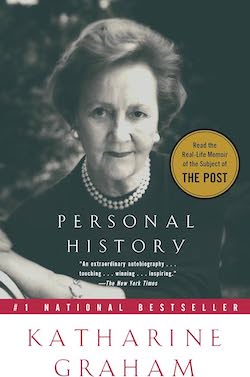
As publisher of The Washington Post from 1963 to 1991, Katherine Graham oversaw some of the century’s major stories in the US, such as the Pentagon Papers and Watergate. This autobiography tells her story, the story of a woman initially unsure of herself, who was thrust into a position she did not think she was ready for, but discovered she was good at.
Katherine[1] was born in 1917. Her father Eugene Meyer was a successful financier, and Katherine and her siblings grew up in big houses with domestic staff. Her mother Agnes was a force to be reckoned with: she was a patron of the arts, a journalist, and an activist who was able to influence government policy on social welfare and education. She expected her children to go far and pushed them, leaving them with a feeling of never being good enough, especially Katherine.
In 1933, Meyer bought The Washington Post, which had been losing money. Katherine’s account of how he bought it and—with very little knowledge of the publishing world—how he tried to turn it around, makes for fascinating reading.
In university, Katherine met her future husband, Phil Graham, a brilliant but ultimately troubled man. They married in 1940, and Meyer persuaded him to take over as publisher, a job that Phil enjoyed and did well, although there was always the feeling that he got it only because he was married to Meyer’s daughter. He was a man of contradictions: on one hand, he involved his wife in everything relating to the paper, but on the other, he downplayed her intelligence and knowledge, and made jokes about her.
Phil became increasingly unpredictable and unreliable, and was diagnosed with manic depression and committed to an institution. He persuaded the authorities at the institution to let him out for a day; he went home and shot himself. Katherine was the one who found him.
Now it was up to her to step up to the plate, as it were. Initially, she saw it as “keeping the seat warm” for one of her sons—the fact that a woman could be a publisher was not something she considered seriously. But as time went on, she came into her own. One of her biggest decisions was appointing Ben Bradlee as editor. The two developed a close friendship and worked well together, especially during the Post’s exposés of the Pentagon Papers and the Watergate scandal.
She developed a reputation as a strong leader. After an interview with Soviet leader Mikhail Gorbachev, she was approached by Soviet officials, who wanted her to use their official transcript and reformulate one of the questions. She refused and published the original interview.
The first part of the book—her childhood and early life—was for me, less interesting. She grew up with lots of domestic staff, who took care of everything. When she started living on her own, she had no idea how to do anything that related to daily life, such as doing the laundry, shopping and so on. Although her helplessness at the practical stuff had me rolling my eyes, the way she tells it is funny.
The book takes off when Phil enters the scene, and specially later, when Katherine takes over the Post (the bit I enjoyed the most). Publishers in those days were more involved in political campaigns than they are now, and Phil became friends with Lyndon B. Johnson and later with John F. Kennedy, whom he persuaded to take on Johnson as a running mate.
After his death, you see Katherine trying to cope with it all—the grief, their children, and a job she felt she was incapable of doing, although she was the one who knew the most about the paper. From deferring to others at the Post, she finally developed the confidence to stand her ground and make her own judgements. She faced discrimination as a woman and sometimes, as the daughter of a Jewish father.
This book takes you behind the scenes of The Washington Post and what it takes to run a major newspaper. It is not only about getting the journalism right, but also constant negotiations with unions—the printers would strike regularly. It meant taking the decision to modernize and adopt new technology.
This is the story of The Washington Post, which went from being a paper that was about to fold to one of the most respected newspapers in the country (the book was published in 1997).
It is also the story of a woman born at the beginning of the 20th century and the changes she saw during her lifetime—in politics, social mores and in the position of women. She grew up believing that a woman’s place was in the home, taking care of her children and supporting her husband (although that was not the path her mother took). When Katherine Graham took over the Post, she didn’t really see herself as a woman in a man’s world—she was just another publisher. She writes about her slow realization of the obstacles that professional women were up against.
This is an honest book—Katherine does not spare herself (and can sometimes be a little too self-critical). She is a sharp observer and her descriptions of people feel very accurate. She is also funny, and some of her stories had me laughing.
Katherine Graham has become an icon: she was one of the first female publishers of a major newspaper and the first woman to be on the board of the Associated Press. She writes about a 1965 trip to Japan, where she visited the offices of the Japanese newspaper Asahi Shimbun and was applauded by all the women employees of the paper.
This is a rich autobiography: it is a personal account of an interesting life, the growth of a major newspaper and the evolution of a country.
[1] I’m going to use the first names of Katherine and Phil Graham in the review for the sake of clarity.
 Talking About Books