
Published by Sceptre, 2024, 353 pages
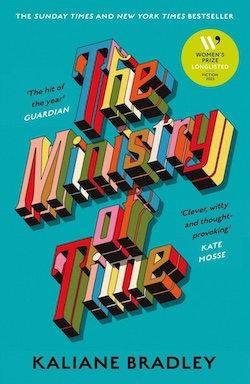
A young British-Cambodian woman is offered a job in a mysterious ministry in the UK that takes care of “expats”. Except that the ministry is working on a project that involves time travel, and the expats are people from different centuries. They select people who had been presumed dead in their time, so as not to change history.
The story takes place in London in the near future. The young woman—the narrator of the book whose name we never learn—is hired to act as a “bridge” for one of the expats, helping them to adjust to the new times. She is assigned to Commander Graham Gore, who was on the Franklin expedition in 1845 to discover the Northeast Passage. All the men on the expedition died.
There are four others: Captain Arthur Reginald-Smyth, who would have died in 1916 in the First World War; Margaret Kemble, from the Great Plague of London in 1665; Lieutenant Thomas Cardingham, who fought during the First English Civil War in 1645; and Anne Spencer from the French Revolution in 1793. They get to know each other and call each other by their years rather than their names (“45” or “16”). Graham and Arthur become close, and Margaret, or Maggie, joins their group. Cardingham is disliked by all of them, and Anne hardly makes an appearance. She has more trouble than the rest with time travel.
Graham takes a little time adjusting but finds his feet. Maggie is delighted by this new century—she has a lot more freedom than she could have dreamed of, and makes the most of it. Arthur and Maggie are both gay and are now free to love as they choose. Meanwhile the narrator falls in love with Graham, and eventually the two become lovers.
But there is something strange going on. Graham sees a machine or a device and sketches it for the narrator, who cannot make any sense of it. She passes it on to Quentin, her handler at the Ministry, who seems to think it is important. But then Quentin disappears. He tries to make contact with the narrator but before he can tell her anything, he is killed.
The woman who had interviewed her for the job, Adela, takes over Quentin’s work. The narrator is not sure about her but she does not have a choice. Meanwhile, a so-called Brigadier has been hanging around, and one evening, he and a woman attack her and Graham.
Clearly, there is a lot more going on than the narrator is privy to. The ministry is listening to everything, all the time. Things come to a head and the group find themselves fighting for their lives.
The narrator’s account is interspersed with a chronicle of Gore’s last days on the expedition and how he was rescued by the ministry.
Once the narrative moves into action mode, it starts to get a little confusing. Time travel is far more complicated than just moving back and forth in time. There is a time machine involved, one that could be dangerous. But I found myself losing the plot towards the end—and then there is a reveal which I really was not expecting.
What I found interesting was seeing our times from the perspective of someone from the past. I have often wondered what my grandmothers would make of the present, but this goes back a lot further. The romance is a case in point: things were very different then between men and women, and Graham is a little bewildered by the freedom women now enjoy. We are clearly more direct now; in his time, women were courted over a period of time.
On the other hand, the group brings with them attitudes from their time, attitudes that are completely out of synch with the present. The British Empire no longer exists; all we have left is its aftermath.
The narrator’s mother is Cambodian, a refugee from the Khmer Rouge, and her father is British. She draws parallels between refugees and the expats, who are really time refugees. There is also the history that the expats have to learn—it may be history for us but had not happened when they were alive. There is World War Two, for instance: Arthur, who is suffering from PTSD, is horrified to find that after the madness of the First World War, the powers that be started a second conflagration.
This is an enjoyable read, a mix of romance and science fiction. The characters are interesting, especially the three expats: Graham, Arthur and especially Maggie, who is a wonderful creation.
Like good science fiction, this book uses the future to comment on our present.

