
Published by Penguin Classics, 2022, 203 pages. Original stories published 1894–1905.
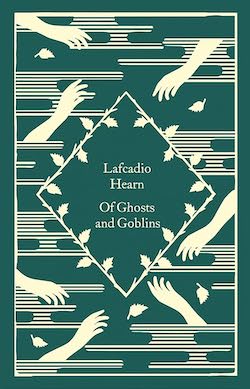
A dying wife summons her husband’s youngest concubine under the guise of handing over her husband’s welfare to the young woman; a monk wandering in a desolate landscape is persuaded by a poor man to spend the night in his home; and a dead woman’s spirit is determined to wreak vengeance on her husband’s new wife.
These are some of the Japanese tales of the supernatural in this collection by Lafcadio Hearn.
He bases the stories on Japanese folktales and makes them his own. Unfortunately, there is no introduction to explain why this Greek-Irish writer produced this book of Japanese stories. The information I could find indicates that he drew on Japanese legends, infusing it with his own Irish heritage.
I’m not sure where the Irish comes in because the stories feel very Japanese (and are considered classics in Japan). Hearn himself is a fascinating character—born in 1850 to an Irish father and Greek mother, he was abandoned first by his father and then by his mother. He was sent to live with his Irish grand-aunt. When he was 19, he was packed off to the US, where he became a journalist. In 1890, he moved to Japan and seems to have found a home there.
Which accounts for these stories. I love the strangeness of Japanese fantasy, and these stories deliver. The Dream of a Summer Day is the story of the fisher-boy Urashima, who goes fishing in a boat one summer afternoon and is taken by the daughter of the Dragon King of the Sea as her husband. When he returns to his home after what he thinks are three years, he finds that four centuries have passed. The story is recounted 1400 years later by a man who stays at a hotel that is run by a lovely woman with a voice “as softly toned as a wind-bell”, reminding him of “moth maidens”. The hotel is called The House of Urashima. Is she human or is this man under an enchantment?
In Rokuro-Kubi, a samurai who becomes a monk is preparing to sleep in a desolate spot when a poor man sees him. This is a dangerous place, he tells the monk, you would be better off in my little hut. So the monk accompanies him on a narrow path that runs along precipices, sometimes with just slippery roots to walk on, until they come to a thatched cottage. There are some other people there, and they give him a room to sleep in. But when the monk, feeling thirsty, goes out for a drink of water, he finds that the people are not human and have evil intentions.
In Ingwa-Banashi, a dying wife summons her husband’s youngest concubine, Lady Yukiko. She wants to hand over the responsibility of caring for her husband to Yukiko. But she has a final wish. She wants to see the cherry blossoms before she dies, and asks Yukiko to carry her on her back. Her request hides a nasty purpose, and Yukiko can never be free of her again.
There are many more stories—a man who sees another man’s face reflected in a cup of tea, a crying woman by a moat who refuses to be consoled or show her face; and the spirit of a young woman who dies from lovesickness (the one thing that the doctors cannot cure) who comes to claim her lover.
Hearn breaks the fourth wall from time to time to explain things to a Western reader, or to indicate missing portions from the story he is translating. His writing brings back an older Japan, a land of samurai and daimyō (feudal landlords), of women in kimonos and wooden sandals, a land where goblins, ghosts and otherworldly creatures exist, as real as the humans they haunt.

