
Translated from Catalan into Spanish by Pere Gimferrer
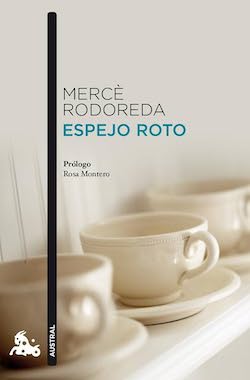
Published by Austral, 2002, 413 pages. Original version published in 1975. Published in English as Broken Mirror, translated by Josep Miquel Sobrer, University of Nebraska Press, 2006.
The book opens with a visit to a jeweller. Teresa Goday—the beautiful daughter of a fishmonger—is at the jeweller’s shop with her husband Nicolau Rovira, a wealthy and much older man. He buys her a large diamond brooch in the shape of a bouquet of flowers.
But Teresa has a secret that Nicolau does not know about. She has a child, Jesús, with a previous lover, Masdéu. Teresa only discovered that he was married after she became pregnant. Jesús has been living with her sister.
The next day, Teresa goes out wearing the brooch, secretly sells it back to the jeweller, and gives the money to Masdéu to adopt Jesús. Teresa then pretends to have lost the brooch and returns home, seemingly distraught. Nicolau promptly takes her back to the jeweller and buys her what he believes is an identical one.
This is our introduction to the central figure in this three-generational saga: Teresa—resourceful, smart, beautiful, and a survivor.
Nicolau dies, leaving Teresa a rich woman. She marries Salvador Valldaura, a diplomat. She hates being out of Spain, so Salvador buys her a house in the country, which becomes the family home. Teresa and Salvador have a daughter, Sofía. Jesús visits Teresa from time to time, believing she is his godmother.
Sofia marries Eladi, a playboy, and the couple have two sons, Ramon and Jaume. Eladi’s affair with an entertainer known as Lady Godiva results in a daughter, Maria. Eladi persuades Sofia to give Maria a home, and the three children grow up together in the Valldaura household. Maria and Ramon form a deep bond. They are the stronger ones and often bully the young Jaume, who is a gentle, delicate boy. Jaume finds refuge with Teresa, who is now confined to her room.
Maria and Ramon fall deeply in love without knowing that they are half-siblings. The knowledge, when it comes, is devastating.
The home is a character in its own right—not just the house, but also the trees and the pond, all of which are witness to the family’s tragedies and downfall. Inanimate objects are very much a part of the story: the brooch we see in the first chapter reappears throughout the book.
The saga spans several decades from the 1870s to the start of Franco’s dictatorship. It is told from several points of view, including that of various members of the family, the maids, inanimate objects and at the end, a rat. Mercè Rodoreda holds up a mirror to society, but it is a broken mirror and the reflections are fragmented. What this does is to build the story in all its complexity and layers in a way that narrating it from one point of view would not have achieved.
The book is beautifully written, like a piece of music—a symphony with crescendos and recurring themes, and a quiet finale. In the end, the past becomes more real than the present, as Teresa, on her deathbed, thinks back to her beginnings. The novel ends with the musings of Armanda, the housekeeper for many years, as she too, looks back. But the final chapter is left to a rat who lives in the house, now empty and starting to fall apart.
Broken Mirror is a rich narrative, filled with intriguing characters, especially Teresa. She knows how to use her beauty to move up the social ladder. She is also a strong, humane woman who tries to take care of those close to her but has a difficult relationship with her daughter. In the end, she is almost paralyzed and confined to her room, a witness to her family falling apart around her.
This is a book about the relentless passing of time, and the growth and inevitable decay that is part of life. Rodoreda wrote it in her 60s, and it reflects the maturity of an older woman.
Rodoreda is a well-known Catalan author, considered the most important Catalan writer of the post-war period. She was born in 1908 and went into exile in France before the end of the Spanish Civil War.
I am going to be reading more of her books.

