
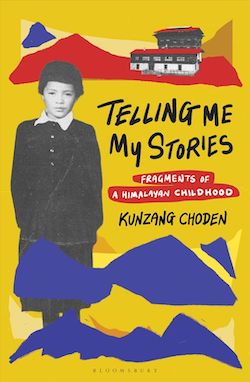
Published by Bloomsbury, 2025, 273 pages
“As I walk through each room, I immediately become immersed in reminiscences of my parents, my brothers, relatives, visitors and attendants, their lives and mine, their stories and the stories of those who lived here before us. Lives from the past can be invoked in each room and through each artefact, but what always overwhelms me is the silence of the untold stories that I yearn to hear. Sometimes, when I am alone, the rooms feel filled with unspoken words, and I find myself unconsciously yearning for those long gone to appear and speak to me.”
Kunzang Choden’s ancestors built their home in Bhutan on a hilltop shaped like an elephant’s head. Although the landscape has not changed since then, the world around it has. In this memoir, Choden looks back at her childhood spent in Ogyen Choling, her ancestral home, a home where more than 20 generations of her family have lived. The house has now been turned into a museum.
Choden’s life is filled with loss. Both her parents died when she was a child. Their presence—and their absence—loom large over the book.
When her mother was in labour with Choden, she needed to use the toilet, and so Choden was born on the threshold between her bedroom and toilet. She was born on a threshold in a larger sense too—it was the end of 1952, and King Jigme Dorji Wangchuck had just ascended the throne. He was responsible for moving Bhutan to a more democratic form of government, establishing the first legislature in 1953, and the first cabinet in 1968.
Choden’s childhood was rooted in a much older way of living, and this comes through in the book—the slower rhythms of everyday life. One of the changes that came with the modernizing of Bhutan was the sending of children to India to be educated. Bhutan was mostly a society with an oral tradition, but a modern country needed young people with a modern education. There was some resistance to this: many parents were not keen to send their children to a foreign and alien land. When Choden’s parents decided to send their son to India, the Ogyen Choling villagers were shocked, and a deputation came to see her parents. In sending their children to study abroad, the villagers felt, the religious lineage of their family that had been preserved for centuries was in jeopardy. But the parents had already started the process. A tutor had been engaged to teach the children English.
Bhutan was losing its insularity in other ways too. Choden remembers Tibetan refugees flowing into the country, fleeing Chinese persecution. They brought with them news of great changes in the north. In Bhutan itself, social reforms had emancipated serfs, upending an age-old social structure.
Along with two of her brothers, Choden was also sent to India to study. Both her parents died while she was away, first her father and then her mother. Communications being what they were at the time, she did not learn of their deaths until months afterwards. She writes about the culture shock of going into a completely different world, an unfamiliar school system, surrounded by girls with whom she had very little in common. The title of the book comes from her attempts to comfort herself at night by remembering her past—“telling me my stories”.
Although she eventually moved to a school where she seemed to be happier, this segment is in stark contrast to her childhood, which seems idyllic.
Her account of her childhood is the part I liked best. Choden immerses you in her world, the world of old Bhutan. She and her siblings were free to play in the forest and the area surrounding the house, which sometimes meant avoiding bears and malevolent spirits. In her account, the unseen world is as real as the seen. Like the man who came by to see her father: soon afterwards, her father learned that the man had died, and he must have been visited by the man’s spirit.
There is so much detail and colour in this segment, which forms the bulk of the book. The visit from the Tibetan Rimpoche and his entourage, quite unlike the Tibetan refugees the children had seen; their unreasonable fear of Kanjurla, a servant of the Queen who would deliver letters and parcels from her to the family; and the details of their meals.
The house is the link between the past and the present and is almost a character in its own right. Choden moves through the house in the present, with memories of the past and the years she spent there, flooding in. Seeing the past from the perspective of the present, telling her stories from her home—now a museum—creates a blend of the past and the present that gives this book its richness.
This is a gentle, vivid memoir that tells the story of a woman and her country.
 Talking About Books
Pingback: The Circle of Karma: Kunzang Choden – Talking About Books
Lovely review Bibi. Do send it to Kunzang and her son
Thanks! I just did. Didn’t want to do it yesterday because it was quite late when I posted it.