
Published by John Murray, 2016, 328 pages.
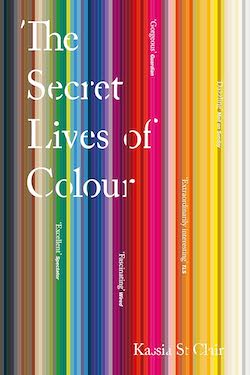
I have always loved colour, from the time my mother gave me a set of colour pencils as a child. Colours are an essential part of our world, whether it’s the blue of a cloudless sky or the brown of the earth; the yellow signage on roads, or the red, amber and green of traffic lights.
Colour is something we tend to take for granted. But what is colour and why do we see it? It has to do with the wavelengths of the visible light spectrum that are absorbed by objects. Take a tomato, for example: its skin absorbs most of the short and medium wavelengths such as blues, violets, greens, yellows and oranges. The tomato does not absorb red, and that is what bounces back at us. We see colours through cones in our retina—we have six million of these in each retina. Dogs have fewer cones, but the praying mantis has double the number of any living creature. This means that the mantis can see colours we cannot even imagine.
Humans have been trying to replicate these colours, whether to dye cloth, as paints for artists, and so on. Although we may be familiar with the names of many of these colours—beige, magenta, navy blue—we know very little about how they came about.
Kassia St. Clair has always been fascinated by colour. In this book, she selects 75 shades—ones with interesting histories—for what she calls “character sketches”. These pigments or dyes—or, in some cases, sociocultural creations—are divided into 10 colour families: the rainbow spectrum, and white, black and brown.
One of the striking things about pigments is just how many of them are toxic. Lead white, for instance. Evidence shows that it had been manufactured in Anatolia as early as 2300 BC. In the 4th century BC, it was applied as a cosmetic to make skin look pale and smooth. More recently, lead white was used on ceramic dishes, house paints and wallpaper up until the 20th century. But lead is poisonous—the cosmetics turned the skin withered and grey, and I remember reading an article in the 1970s about children being poisoned by drinking out of ceramic mugs.
Colours can affect the course of history. Take Mountbatten pink, a lavender-grey-pink shade used by the ships of the Union-Castle company. During the Second World War, Lord Mountbatten, the British statesman, noticed that at dawn and dusk—the most dangerous times for attacks from U-boats and the Luftwaffe—the Union-Castle ships seemed to “disappear into the gloaming”. He had the Royal Navy ships painted in that shade—a medium grey mixed with Venetian red—which became known as Mountbatten pink. It proved an effective camouflage.
All kinds of materials were used to create pigments, including shellfish. During the Roman Empire, Tyrian purple—a rich colour resembling clotted blood—was a sign of opulence. It was made using two types of shellfish: Thais haemastoma and Murex brandaris. The colour was extracted by squeezing a gland, which would yield a single drop of clear liquid. It took 250,000 shellfish to make an ounce of dye. This not only made the dye extremely expensive (a Roman emperor was said to have told his wife he could not afford to buy her a Tyrian dress), but it almost decimated the populations of the Thais and Murex. But when Constantinople fell to the Ottomans, the secret of making Tyrian purple was lost, saving the shellfish from extinction.
The Secret Lives of Colour is full of interesting facts like these. St. Clair goes into detail about how these pigments were made (some of the processes will make your stomach turn), and how they were used. All this information is delivered with a light touch and a sense of humour. In the chapter on Gamboge, a bright yellow, she writes that George Field, in his 1835 treatise on pigments, “waxed evasive”.
St. Claire tells a fascinating story. This is a wide-ranging book, covering natural history, and the history of writing, politics, warfare, art and much more. I read it cover to cover but you can also dip into it. The book is beautifully produced, and it is worth getting the print version. It will give you many hours of pleasure.
 Talking About Books
Sounds amazing! I am definitely going to buy this book…maybe will buy it for Ragini.
I think she’ll like it. I enjoyed the book.