
Translated from Spanish by Daniel Hahn
Published by Charco Press, 2022, 156 pages. Original version published in 2011.
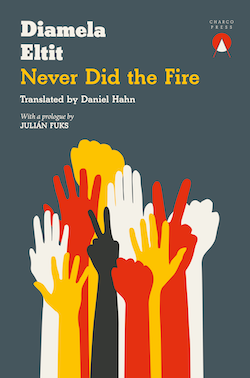
How do you live after you lose everything, when the ideals you devoted your life to are gone, when the people you worked with are dead or no longer around? How do you live in close proximity to someone you can barely stand?
The couple at the centre of Chilean writer Diamela Eltit’s Never Did the Fire were once revolutionaries, but are now old and poor and alone. The man, who used to be a leader of a revolutionary cell, is now bedridden—partly as a result of torture—and almost never leaves his apartment. The woman, who is the narrator, works as a private carer, giving elderly people their weekly bath. The couple are just about managing to make ends meet, living on rice, bread and tea. They have nothing left, not even the love they may have once had. She cannot bear him, yet they are squeezed together on a small bed in a dingy little apartment.
She is angry with him, angry with his failing body, angry with his refusal to listen to her when she remembers the past and tries to untangle it. And then there is the child, a child that the man never wanted. (His reaction was, “Can’t you get rid of it?”) Even though she refers to her pregnant form as “deformed”, she decides to have the child and loves him. When he is two, he falls sick and has trouble breathing, maybe because of the paraffin fumes from the stove. But the man refuses to take him to the hospital because the regime is looking for them, and they would risk arrest. As a result, the child dies, something she never forgives him for.
Whatever else they may have been, the couple, like many of their comrades, believed in their leftist ideology (anti-capitalist, anti-bourgeoisie, anti-consumerism), to the extent of giving up their lives for it. There is an incident she recounts about how she once looked in a shop window and fell in love with a dress. She wanted that dress, she wanted to step out in high heels and lipstick. But she has erased the physical sense of herself so completely, has become so subsumed in the ideology, that she sees this normal desire as a betrayal. It is an incident that lingers in her memory as a sort of a cataclysm.
The book is claustrophobic: claustrophobic because the man and the woman are trapped in a tiny space, in a tiny life that is peopled by ghosts; claustrophobic also because you are witness to people trapped in aging bodies, bodies they can no long control.
You get the story through her narration, through her anger and sorrow. She talks to him, referring to things he knows so as readers, we are often trying to fill in the blanks. What is real are the references to decay, whether physical, emotional or political. She describes the revolutionary cells the couple was part of, cells of ten people, each with their individual function. But those cells eventually fell apart, whether from internal politics, disagreements or the regime’s crackdown. Just like the cells in a human body that fall apart, unable to perform the functions they were created for.
As the book progresses, we get a little more clarity about what happened and piece together their past: the arrests, the torture, the safe house they were moved to and where they still live. The only proper nouns in the book are occasional names and aliases of their comrades. “We don’t depend on civilian names, we remain attached to our last aliases, we’ve already gotten used to them, or taken possession, I don’t know. But if somebody was to say my civilian name, I wouldn’t turn towards them. What for. You could be in the crosshairs, for sure, it would be you.” There is no reference to the city, street names or politicians. Were they arrested by Pinochet’s regime? Or is this a more general story?
This is a dense book. Not something I would recommend for everyone. Her story emerges through the bits of information that come to us through the fog of her emotions, small glimpses that become clearer as the book nears its end.
In his translation, Daniel Hahn captures the sense of hopelessness, fear and anger that permeates the book. I’m not sure I understood all of it, to be honest. At first I was not sure about the book, but found it strangely compelling. (Note: Hahn has written about how he translated Never Did the Fire. The book is called Catching Fire and is published by Charco Press.)


Pingback: The Best Books of 2023 – Talking About Books