
Published by Vintage / Jonathan Cape, 2011, 230 pages
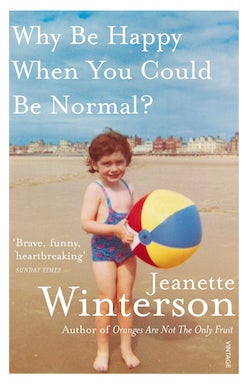
When she was 25, Jeanette Winterson wrote Oranges Are Not the Only Fruit, a fictionalized account of growing up as an adopted child in a Pentecostal community and coming out as a lesbian. This book, written when she was 50, tells the same story, but this time as a memoir.
She was adopted by Mr. and Mrs. Winterson, and grew up in Lancashire, UK. Her adopted mother, whom she refers to as Mrs. Winterson, was a figure larger than life: obsessively devout, humourless and unable to love.
“God is forgiveness—or so that particular story goes, but in our house God was Old Testament and there was no forgiveness without a great deal of sacrifice. Mrs. Winterson was unhappy and we had to be unhappy with her. She was waiting for the Apocalypse.”
She would punish Winterson by locking her in the coal cellar or leaving her to sit on the doorstep outside the front door all night.
Mrs. Winterson’s house was an emotionally cold and sexless place. There were quotes from the Bible everywhere, and she would stay up all night so she did not have to share a bed with her husband. He was the saner of the two, and Winterson was fond of him, although he was far too intimidated by his wife to do anything about the abuse.
Winterson found escape in books. Reading was not something Mrs. Winterson approved of. There were only six books in her house, including the Bible, of course, and for some strange reason, Thomas Mallory’s Morte d’Arthur. Winterson discovered the local library and started on English Literature in Prose, A-Z. But Mrs. Winterson found the stash of books hidden under her mattress and burned them. These were dangerous things, and the girl was to stay away from them.
“Yes, the stories are dangerous, she was right. A book is a magic carpet that flies you off elsewhere. A book is a door. You open it. You step through. Do you come back?”
Things only became worse when, at 16, Winterson realized she was gay, and Mrs. Winterson found out about her affair with a classmate from school. It resulted in her being kicked out of the house. “Why be happy when you can be normal?” her mother demands. Winterson got into Oxford and hardly saw her mother again.
Winterson’s childhood left emotional scars that she dealt with for most of her adult life. She had trouble maintaining relationships. She assumed it was because she didn’t know how to love. But as one of her partners pointed out, her problem was not being unable to love, but that she did not know how to be loved, how to trust the fact that someone could actually love her. In 2008, after the break-up of a long-term relationship, she tried to commit suicide.
After her mother died, Winterson found her own birth certificate, which led to her tracking down her birth mother. Mrs. Winterson always told her that her mother was a young machinist who had given birth to her at 17, “easy as a cat”. The truth was that Ann, the birth mother, was just too young to take care of a baby and genuinely thought that her child would have a better chance elsewhere.
Ann’s home is very different from the one Winterson grew up in—full of life and laughter and love. Meeting her—and her half siblings—is rewarding but also emotionally complicated.
This is a slim but rich book. There is a deep understanding of how we deal with pain and emotions. How we substitute anger for our feelings of loneliness, fear and inadequacy—a “feelings-swap”.
But this is also Winterson’s attempt to understand her adoptive mother. She was an intelligent woman, “gloriously wounded”, who had shut herself off emotionally and was therefore very lonely. She loomed large over Winterson’s life, as she does over this book. Winterson writes about speaking to her from a phone booth after Oranges Are Not the Only Fruit was published. Mrs. Winterson was livid about the book and her fury came through the line.
“She filled the phone box. She was out of scale, larger than life. She was like a fairy story where size is approximate and unstable. She loomed up. She expanded. Only later, much later, too late, did I understand how small she was to herself. The baby nobody picked up. The uncarried child still inside her.”
This is one of my favourite books and one I reread, and it moves me to tears each time. It is a devastating and beautiful book about survival, pain, trauma, forgiveness, understanding, and much, much more.
 Talking About Books
Pingback: Suroor’s Favourite Books – Talking About Books
Pingback: Revisiting old favourites – Talking About Books