
Published by Algonquin Books of Chapel Hill, 2022, 258 pages
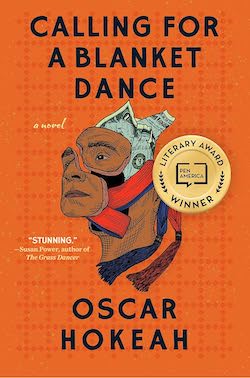
A story told by several family members, Calling for a Blanket Dance centres around Ever, a man with a Cherokee-Kiowa mother (Turtle) and a Mexican father (Everado). But it is also a story about the Geimausaddles, Ever’s family.
Turtle’s mother, Lena Stop, is a Cherokee, and is estranged from her Kiowa husband, Vincent Geimausaddles. She is the one who begins the story, narrating how Turtle insisted on taking her family to Mexico when Ever was six months old to meet Everado’s parents. On the way back, they are stopped by the Mexican police, who beat Everado up. He is badly injured, with permanent kidney damage. This means that not only does Turtle have to take care of him and raise her family on her own, but also deal with his rage. When he becomes impossible to handle, Turtle and her children move to a shelter.
Turtle turns to her father, Vincent, getting him to babysit Ever while she works. This gives Vincent, an alcoholic, a new lease of life. He gives up booze and takes it on himself to teach Ever and his cousin Quinton the traditional Kiowa customs, including the blanket dance, which is carried out when someone is in trouble and needs help from the community. The fact that he is diagnosed with cirrhosis only gives his task greater urgency.
One after another, 11 family members tell us about Ever, each one taking the story a bit further. Unlike his sister Yvonne (Sissy), Ever hates school and tends to run away when the school bus appears. One day, Ever goes into the shop of his uncle, Hayes Shade, and they get talking. Hayes helps Ever deal with his fears by telling him about the booger mask. When Hayes was a child, he was terrified of the snake-like pods of the locust tree in their front yard. His mother sent for the medicine man, who made a mask from the seeds of the pods. Wearing that mask banished his fear, and he gives one to Ever.
“Time, like masks, could make us reclaim the best of who we were and purge the worst of what we’d become. Ever faced the mask, faced his fears, and I hope the mask healed him the way it once healed all Cherokees.”
We see Ever through the eyes of his relatives, including his adopted son, but we do not hear from him directly—until the very last chapter, which is his. By that point, we know him well from so many different perspectives that meeting him in person feels like a revelation. By now, he is an older man—the story starts in 1976 and ends in 2013.
I loved this book. It pulls you into its world. There are 12 narrators, and each of them has a distinctive voice, a distinctive point of view. You get a fragmented narrative that joins together to form a whole. Lena makes quilts—some she makes on orders, but the ones that matter are ones she makes for her family, quilts that will heal and protect the recipient. These quilts are like this book: short pieces that come together to make something beautiful.
I’m not sure that I have done justice to the book. It is so much more than the story of one man—it is the story of a family and a community. It is about toxic masculinity and the pain and scars that are passed down through generations. It is also about the importance of how keeping customs and traditions alive can ground people and help them find their way. And most of all, it is about the power of those who love you to help you heal.
 Talking About Books