
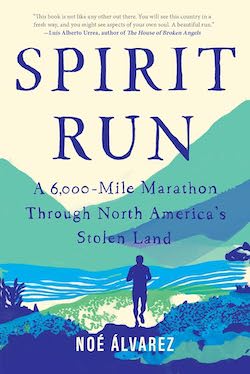
Published by Catapult, 2020, 218 pages
“We continue to slip in and out of society like ghosts in the night, connecting our hearts and minds with the land and the many tribal peoples who cross our paths every single day, carrying the heavy thread of the prayers of hundreds of individuals. We run through landscapes that are referred to by their original Native names. Reinvoking the power of a name. Landscapes that start to take the form of our traumas and offer some healing. My body is weary and time and place become one big blur on the run.”
This is about a run across North and Central America as a way of reclaiming Indigenous identity, about finding a way of healing.
The book begins with a clash between Native American culture and the interpretation of US law. A Secwépemc mother secretly buries her dead baby in the woods, giving him a funeral with the customary ceremony of her people. But the authorities find the grave and dig the child up again, “reversing the sacred order by which a Secwépemc mother makes peace with the loss of a son”. The mother is taken into custody for questioning. These seem to be two different worlds, with a seemingly impassable gulf between them.
Indigenous culture is at the heart of this book. After the story about the mother, Noé Álvarez then introduces us to those who are leaving their lives behind to join a group of Indigenous people running across North and Central America, from Alaska to Panama. We will meet these people again.
The marathon is at the centre of this book: it is the Peace and Dignity Journey (PDJ), a ceremonial six-month run that happens every four years. It was set up as a way of preserving Native American culture and renewing connections among Indigenous people across the Americas.
Álvarez is the child of Mexican immigrants, descended from the Purépecha of Michoacán, Mexico. He lives in Yakima, Washington state, with his parents who work at a fruit-packaging plant—hard, repetitive labour that takes its toll on their bodies. Although he gets a job at the plant and works there for a while, both his parents are determined that their son will make a better life for himself. So when he gets a scholarship to study at Whitman College, Washington, they are delighted.
But college is not easy. Álvarez struggles to fit in—he has very little in common with the other students, and course work is much harder than he had expected. His one consolation is running, the thing that kept him going in Yakima.
And that is what eventually saves him. In college, he comes across a brochure about PDJs. The next run is starting in a month. He buys a one-way ticket to Prince George in British Columbia, Canada, and joins the run.
The first night, when he joins the group, many of whom have already been running for a month from Alaska, he gets a sense of what awaits him. “Slouched and huddled around the thin coils of smoke rising from a dying campfire are people who look as if they’ve just come back from battle. They have a hard look on their faces, ones that weigh heavily from all the running… They’re tired. Tired of eating and sleeping too little. The discomforts of the outdoors, and their wet, moulding clothes.” Soon Álvarez will be one of them.
The run is gruelling and pushes Álvarez to his limits. He runs through forests, mountains, and cities, and even faces down a mountain lion. There is a van that accompanies the runners, and they take turns at riding part of the way. But Álvarez has to prove himself to the group, who are not welcoming to newbies who join for a while and give up.
Álvarez used to associate running with running away, a vulnerable people’s way of survival. But as he runs the PDJ, he starts to see it also as a form of connection, not just with his fellow runners but with the people who have gone before, the migrants—like his parents—who have made the journey across the land, a journey that they filled with their hopes for a better life.
Álvarez’s story is a testament to determination and to the healing power of running—although it does not always feel that way. There is pain and exhaustion, discord within the group, but also a sense of camaraderie.
The writing is evocative. Álvarez writes about Yakima, a beautiful, fertile place which is one of the leading producers of apples, cherries, hops and grapes. The sign welcoming visitors calls it The Palm Springs of Washington. The reality beneath the surface is much harsher. “It is a region that cycles through its most vulnerable people—immigrants who plant and plow.”
His portraits of his parents, especially his mother, are touching. His mother is in constant pain from the repetitive work she does all day—work that she has been doing for years, work that has put food on the table, but has damaged her physically: misaligned joints, varicose veins and the muscle above her shoulders “like a bull’s hump”. In spite of this, she finds the time, after her work is done, to cook meals for her family.
In the end, Álvarez makes the right decision to run. It is physically draining but it helps him heal and sets him on the path he needs to be on.
This is a thoughtful book about an inspiring journey.
 Talking About Books