
Authors: Bridget Collins, Laura Purcell, Elizabeth Macneal, Imogen Hermes Gowar, Jess Kidd, Natasha Pulley, Kiran Millwood Hargrave, and Andrew Michael Hurley
Published by Sphere, 2021, 293 pages
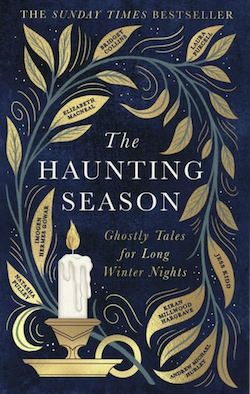
There is something about December that seems to call for ghost stories. So I have picked a collection of eight ghostly tales written by contemporary writers. The stories are intriguing and for the most part, set in the past.
In A Study in Black and White by Bridget Collins, Morton is taken with a black-and-white house in a village. On a whim, he rents it and moves in immediately. The house and its garden remind him of a chess board. He learns that the owner had built it in memory of his son, who died young and, like his father, was passionate about chess. Morton starts to play chess on a set he finds in the house. When he returns to the board, he finds that a piece has been moved. Is it his imagination or does he have a ghostly opponent?
Kiran Millwood Hargrave’s Confinement is more ambiguous. It is narrated by Catherine, a young mother, who swears she is telling the truth. The story begins when she is pregnant, confined to her house, which she shares with her husband, and the couple who keep house for them. One day, walking to the church, her husband tells her about how the woods are haunted by the spirit of a woman who was hanged for stealing and killing babies. After that, Catherine is convinced that the woman’s ghost wants her child. No one believes her when she tells them that she has seen the witch, especially once her baby is born. What is happening here? Is Catherine telling the truth or is she going through a severe case of post- or ante-natal depression?
A young mother is also at the centre of Thwaite’s Tenant by Imogen Hermes Gowar. Lucinda has escaped from her violent husband, taking their son Stanley with her. Her father, although unsympathetic, takes them to an empty house that he owns, where she can stay until—he hopes—she comes back to her senses and returns to her husband. However, it is pouring with rain on the night they drive there, and the carriage gets stuck. He sends her on to the house with Stanley, while he stays behind to help the coachman. When Lucinda tries to sleep at night, she hears a man in the house thundering around. But clearly, he is not the only ghostly presence. When it seems that Lucinda has no choice but to return to her husband, help comes from an unexpected quarter.
My favourite story in this collection is Natasha Pulley’s The Eel Singers, an evocative and eerie tale. Keita Mori “could remember the future and…he did not enjoy it”. There are a handful of places where he can escape his premonitions, places that seem insulated, in a way. Places like the Fens. Mori, with his little family—his lodger and friend Thaniel and an eight-year-old girl, Six—go to the Fens for a holiday. Although Mori finds relief in becoming normal, Thaniel starts to sleepwalk, something he has never done before. And each night, he finds himself a little closer to the water. It feels as if there is a force that is determined to drown him. And then there is that strange song that the villagers sing, a song that buries its way into their consciousness, and that Thaniel knows is about a woman turning into an eel, although the song’s language is not one he understands.
The stories in this collection are uncanny and, well, haunting. Perfect to curl up with on a dark night!
Sphere seems to publish these collections regularly. This is the second one I’ve read. They’re worth looking out for—I enjoy the modern twist on what is an old, old form.
Read my review of Sphere’s 2023 collection, The Winter Spirits—Ghostly Tales for Frosty Nights.
 Talking About Books
Pingback: The Winter Spirits—Ghostly Tales for Frosty Nights – Talking About Books