
Translated from Norwegian by Becky L. Crook
Published by Penguin, 2017, 144 pages. Original version published in 2016.
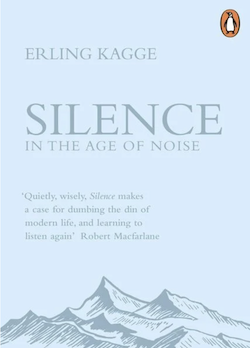
“Whenever I am unable to walk, climb or sail away from the world, I have learned to shut it out.
“Learning this took time. Only when I understood that I had a primal need for silence was I able to begin my search for it—and there, deep beneath a cacophony of traffic noise and thoughts, music and machinery, iPhones and snow ploughs, it lay in wait for me. Silence.”
Silence is precious, especially in the world today. We are bombarded with noise. Not just physical noise like traffic, but also demands on our attention such as the pinging of our smartphone notifications. We are expected to respond immediately to messages, we doomscroll on social media, we are exposed to 24-hour news. When do we have the time to sit back and think?
In this book, Erling Kagge—explorer, philosopher and writer—attempts to answer three questions: what is silence, where is it, and why is it more important now than ever?
Silence means going into yourself, being present in the moment. As Kagge puts it, it is letting each moment be enough instead of living through other people and other things. It is also a question of putting some distance between you and the world—of shutting out the distractions and focusing on what is in front of you.
Kagge experienced utter silence in the Antarctic. He was dropped at the northern edge and spent the next 50 days walking to the South Pole. He left the batteries for his radio in the rubbish bin, thus ensuring that he was completely cut off from the world, with no distraction or noise. The effect this had on him was that he started noticing things in far more detail than he done until then. The way the shades of snow and ice changed all the time. He wrote in his journal that, instead of enjoying “big bites”, he was beginning to appreciate the “miniscule joys”. Left alone to his thoughts, he was entirely present in his surroundings: neither the future nor the past seemed relevant. (Of course, it was not all easy going. The wind was fiercely cold and there was no shelter while he walked.)
You do not have to go to the Antarctic to find silence, or even far into nature. You can find it in yourself—the stillness where everything else seems to recede. It happens when you are completely focused on a task, or doing something routine—washing dishes or ironing, for example.
Kagge writes about the people in the American base at the South Pole. At Christmas, everyone was given a stone: something that was not ice or snow, nor man-made, which was all they had been exposed to. The stones—just ordinary ones that we would barely notice—became something precious, and everyone sat around quietly, just looking at their gifts.
Kagge believes that words take away something from the moment, “destroy the atmosphere”. He writes about Claus Helberg, a war hero and mountain guide in Norway, who, at the start of a hike, handed out slips of paper to his group that said, “Yes, it is totally amazing”. He wanted to let the group concentrate on how amazing everything was instead of feeling the need to constantly remark on it.
Kagge says that the one sentiment he hears at birthday parties for those over 60 is “All of those days that came and went—I didn’t realize those were life”. He thinks that the fear of not having lived is greater than the fear of death. The regret of not being present in your life, of having existed rather than having lived.
This is a philosophical, thoughtful book, which makes you think about silence. It is worth taking a break from the world and going into yourself. It is why pilgrimages are important—it is the walking, day after day, that quiets something within you, leaving your mind free to noticeyour surroundings. I find it when I’m photographing a small area (rather than taking pictures as a record of something). In looking at the tiny details, finding the right angles to take the photo, I forget all about the world around me and live in the moment.
It is a wonderful feeling. And Silence has reminded me that I do not do it often enough.
This is a book very much for our times, and is well worth reading.
 Talking About Books
Very well written. This is most certainly added to my TBR pile.
Thank you! Enjoy the book.
Pingback: A Book of Silence: Sara Maitland – Talking About Books