
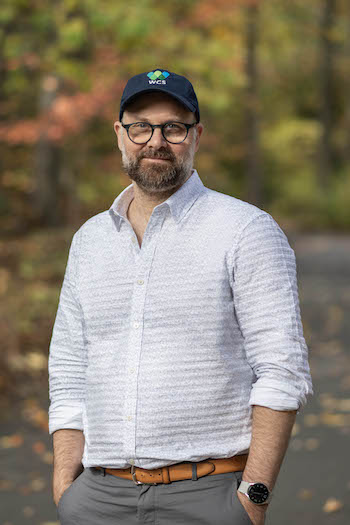
Jonathan C. Slaght is an American wildlife biologist and author.
He is one of the leading experts on Blakiston’s fish owls. His book, Owls of the Eastern Ice: The Quest to Find and Save the World’s Largest Owl (2020), won several awards, including the 2021 PEN/E.O. Wilson Literary Science Writing Award, the 2021 Minnesota Book Award (general nonfiction), and the 2021 Times of London Nature Book of the Year. In 2020, it was voted a The New York Times’ Notable Book, and included in The Wall Street Journal’s 10 Best Books, and the Smithsonian Magazine’s Best Science Books.
His new book, Tigers Between Empires: The Improbable Return of Great Cats to the Forests of Russia and China has just been published.
Jonathan works for the Wildlife Conservation Society (WCS) as the Regional Director of the WCS Temperate Asia Program, overseeing programs in China, Mongolia and Afghanistan, and support projects in Russia and Central Asia.
He contributes the photo blog, WCS Wild View, and used to write a blog for Scientific American called East of Siberia. His writing and photos have also been published by the BBC World Service, The New York Times, The Atlantic, The Guardian, Smithsonian Magazine, The New Yorker, and Audubon Magazine.
Talking About Books asked him about his work with wildlife, and specifically, his time researching fish owls.
TAB: What drew you to research fish owls?
JCS: I’ve been interested in birds since my late teens and heard about fish owls on my first trip to Primorye, a province in the Russian Far East, in 1995. I returned to Primorye for a three-year stint in the Peace Corps (1999-2002), where I began spending time with Russian ornithologists and learned more about the conservation challenges facing the region’s wildlife. I quickly understood that the threats to Primorye’s biodiversity were outpacing the ability of scientists and civil society to counter them. Blakiston’s fish owls were one of the endangered species under significant threat, but with so little known about these birds, it wasn’t clear how best to protect them, so I decided to lend my skills to the cause.
TAB: Primorye seems to be a special place for you. You have researched songbirds there, as well as fish owls and tigers. What, for you, makes Primorye so special?
JCS: Primorye is an amazing place; an amalgamation of the wonderous and the improbable. It is a strange place with a thousand years of human history, where subtropical species such as tigers and leopards wander temperate forests, brushing past boreal species such as lynx and brown bears. The human population density is quite low—in some counties only 1.2 people per square kilometer, so there is a palpable sense of adventure in the forests here. There are unknowns to be discovered; anything could be around the next corner from a tiger to a ninth-century ruin.
TAB: You also write about the people you met in Primorye: many of whom were often eccentric and individualistic. Can you share your impressions about some of these people?
JCS: A certain kind of person is drawn to wild areas, to the rough edges of civilization. Others are born there and know no other life. I’ve seen the same personalities in different remote regions of the United States and Russia. Irrespective of why someone in in Primorye, there are common characteristics of doggedness, ingenuity, persistence, and pragmatism among the residents of the deep forest. You have to be tough and a little crazy to thrive here.
TAB: What was the most memorable moment from your field research? And its lowest point?
JCS: There was a lot of adventure during my fish owl fieldwork days—crossing flooded rivers, encounters with wildlife, and meeting colorful locals—but one of the most thrilling moments was always recapturing fish owls and downloading a year’s worth of movement data from their trackers. No one had done this before with this species, and being able to see where they went, and then speculate what they did there, was almost impossibly exciting. Importantly, we were able to convert this raw data into conservation recommendations still being followed today.
But for this work to be successful, it was essential that I first catch some owls! A low point was early on, during my first season, when I was living in a tent at -30C and absolutely unable to catch any of them. I was cold almost constantly, physically exhausted from being awake much of the night, and mentally drained from my constant failures. I thought briefly about giving it all up.
TAB: Would you like to tell us about your new book on the return of the Amur tigers?
Amur tigers, more popularly known as Siberian tigers, almost went extinct in the 1990s after the fall of the Soviet Union. My new book, Tigers Between Empires, is the dramatic story of the international team that banded together to study and protect these vulnerable cats in the forests of Primorye and adjacent northeast China.
TAB: Your work with the Wildlife Conservation Society includes overseeing programs in Afghanistan. How has the wildlife been affected by the current situation in the country?
JCS: Wildlife always suffer whenever and wherever there is human conflict, and Afghanistan has endured years of such conflict. The Wildlife Conservation Society works mostly in the Wakhan Corridor in northeast Afghanistan, a breathtaking valley separating the steep slopes of Tien Shan and Pamir Mountain ranges, and home to wild sheep and snow leopards eking out a living alongside scattered pastoralist communities. The remoteness of this location has shielded wildlife from significant losses, but poaching and climate change are significant threats.
TAB: You write about the difference between conservation and preservation. Do you think there is a place for both in saving wildlife and its habitat? Can humans share a habitat with wildlife without adversely affecting it?
JCS: Yes, absolutely, there are definitely parts of the world where this is possible, and northeast Asia is one such place. Think about Amur tigers—these cats require massive home ranges in order to secure food and to reproduce—and their populations are growing. A single male might occupy a territory up to 1,400 square kilometers. All that space for just one tiger! So if there is a growing population of Amur tigers, and a decent current estimate is 500-550 adults, then this means that there is a functioning ecosystem to support them: everything from Korean pine forests, which feed chipmunks and wild boar and bears with their calorie-packed pine nuts, all the way up the food chain to tigers. These tigers move across roads, skirt past logging operations and fish factories, and slink past human settlements. Coexistence is possible.
TAB: When did you start writing? Is it something you’ve always done?
JCS: I remember writing as a child. I had a typewriter in my bedroom and would write a few lines of a story before school, leave, and when I’d return my mother had added a few lines of her own. We would progress this way, weaving a narrative together.
But I did not start writing in earnest until graduate school, when I needed to raise all of my own funding for my fish owl research, and was competing against other young researchers for limited pools of funding. I was at a disadvantage trying to raise support for an owl no one had heard of, in a part of the world no one could visualize. So I made a conscious effort to depart from the dry scientific language of a standard grant proposal and opt instead for a more descriptive, narrative approach. My goal was to hook grant reviewers with my story and try to get them emotionally invested. This did not always work but it did sometimes, and I began to hone my narrative skills from there.
TAB: Thank you for sharing your love of wildlife. I sincerely hope we can find a way to successfully coexist with other species that we share this planet with.
Read my review of Johnathan C. Slaght’s Owls of the Eastern Ice.
 Talking About Books
Pingback: Owls of the Eastern Ice—The Quest to Find and Save the World’s Largest Owl: Jonathan C. Slaght – Talking About Books