
Published by BluOne Ink, 2023, 540 pages
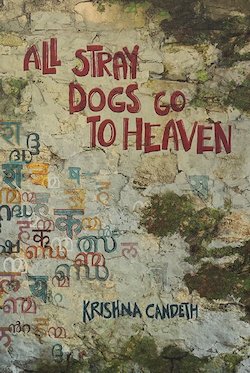
“We eat our poisons young and then trawl the world the rest of our lives, looking for antidotes.”
Humans are intrinsically storytellers, and the stories we tell about ourselves shape who we are. They give form to our world, and each of us carries our own personal world of stories within us.
Before I go any further, in the interest of disclosure, Krishna Candeth is a friend.
All Stray Dogs Go To Heaven is a world created through a web of stories. It centres around Nitya, born in Kerala, India, into a family of matriarchs—his mother’s sisters—who dominate the family. The aunts, each one of them a little larger than life, manipulate to get what they want, squabble with each other, then make up before falling out again. They write long letters to each other, letters full of gossip about the other sisters. They always end with an injunction, burn after reading. Needless to say, the recipient has no intention of doing this: the letters would serve as useful leverage against the writer in the future.
Nitya feels that they all deserve nicknames of their own. A drawing of a lady lion tamer on a matchbox reminds him of one of the older aunts, one who made you feel unwanted and useless by her sharp tongue: he was going to call her LLT (lady lion tamer), shortened to Elty. Then there is the aunt “who was the true stuff of children’s nightmares”; he would call her Yali, after the mythical creatures sculpted into temple pillars. The incendiary aunt who was constantly causing trouble became Mbox (for matchbox), and another was Hawk Knife.
And then there was the aunt he did not know about but discovered quite by chance. He came across a photo of his father, Pibi, with a woman—they were quite clearly newly married and in love. He discovered that she was his father’s first wife and his great love, Chiri, who died young. She was also his mother’s sister; a few years after her death, Pibi married Nitya’s mother, Inji.
Central to the family is Suvastu, the family home Nitya’s grandfather built, which is almost a character in itself. It is where the sisters grew up and Nitya spent a lot of time as a child. After Pibi dies, one of the sisters suggests Inji buy out the other sisters so she can have a home of her own, but Mbox manages to scuttle that plan. Inji spends the rest of her life without a home to call her own, and never forgives her sisters for it.
As a young man, Nitya is haunted by something a sage tells him, that he is a man who has forgotten to live. Tied to his family and also desperate to get away from them, he tries to break free and find his own path. He has a small group of friends; each of them has an important influence on his life. Especially Chinma, a schoolfriend who becomes a guru and whom he joins on a pilgrimage, an experience that marks him.
The novel starts out as a story about family and then takes a more serious turn (there is an incident in a cave that foretells the darkness to come). The novel begins with Chinma’s notebook, found after his death, and one of the last chapters—its darkest section—is about Chinma’s time with the Naxalites (a Maoist insurgency) in the forest.
It is hard to summarize this book: the stories spill out. Candeth immerses you in his world, changing perspectives and points of view, moving between the real and imaginary, between reality and dreams. The book is teeming with characters, so much so that I lost track of some of them. A list at the beginning would have been helpful!
Candeth is also a filmmaker, something that comes through in his vivid and evocative writing. A hawker calls on the street for people’s old newspapers and bottles (referred to as kabaadi): “Kabaadi! Kabaadi! Kabaadi!—was itself like an echo, so frail and distant and mournful it was, almost splintering in the rain as the hawker, an old man with a hennaed beard, panted up the street, the rain running off a blue checked cloth he had wound around his head.” Or Nitya looking at the “yellow comet of an oriole as it skimmed the top of the mangoes that hung proudly like gifts temporarily out of reach, a purple shade creeping daily over the bright green of their ripening bodies”.
Or the young woman in the forest, who, in spite of the violence and war around her, is washing clothes, as she does every day. “In every broken corner of the world, devastated by war and the lies and arrogance of governments, there will always be women like her, wringing and hanging out to dry, the clothes they have washed of their living and their dead.”
The way this novel is structured works—the stories are told in short vignettes, which form larger chapters. I wasn’t sure if the vignettes would work, whether they would make the book more fragmented: sometimes the pieces end abruptly. But the book works like a mosaic—the parts form a whole.
This is ultimately a book about the meaning of home, and of family and friends—the ties that bind us to others and that make us who we are.
I found All Stray Dogs Go To Heaven an immersive read and thoroughly enjoyed it.
Read the Talking About Books interview with Krishna Candeth.
 Talking About Books
Pingback: Weaving Stories: An Interview with Krishna Candeth – Talking About Books