
Published by One, 2020, 217 pages
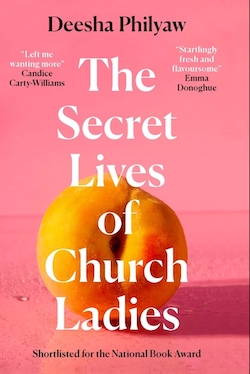
A girl watches her mother make the perfect peach cobbler every week for her date with the married pastor; a woman writes to her half-sister about whose existence she learns only after their father dies; and two women live together in the cold north, far from their southern roots.
These are stories about Black women who have grown up within the church and are now caught in the intersection between the church’s teachings and their own desires. Like Rhonda and Leelee in Snowfall. The two women are a couple, something that their mothers could not accept—as far they are concerned, lesbians are an affront to their values. So Leelee and Rhonda move north, a place where they are accepted, but a place that will never be home. It is cold and snowy, and they miss their families and the warmth of the south. “We miss how they laughed and were easy with each other. How their friendships lasted lifetimes, outlasting wayward husbands and ungrateful children.”
In Eula, religion also gets in the way of a relationship. Caroletta and Eula, two best friends spend a New Year’s Eve together and end up in each other’s arms. Every 31st December after that, they spend the night together. But Eula feels guilty, that what they are doing is wrong, and she needs to find a man so that she can be “normal” again.
In Peach Cobbler—the longest story in this collection—the dessert is central to Olivia’s coming of age and her need for love, especially from her mother.
Olivia’s mother makes the perfect peach cobbler for Pastor Neely every week. A peach cobbler that Olivia is never allowed to eat, not even if the pastor doesn’t come: Olivia’s mother simply throws the cobbler in the bin. Since Olivia cannot have her mother’s peach cobbler, she has to learn to make it herself. So she observes her mother, “watching, close enough to have memorized all the ingredients and steps by the time I was six”. And because her mother refuses to buy her peaches, Olivia has to wait until she is 14 and has earned her own money before she can try the recipe.
The peach cobbler is a symbol of love and desire. Preparing food for someone is an act of love, but Olivia gets TV dinners while the pastor gets the perfect cobbler. Mother and daughter have a complicated relationship, with Olivia desperate for her mother’s affection, and her mother determined that her daughter will not “go through life expecting it to be sweet, when for her, it ain’t going to be”. Olivia’s mother is having an affair with Pastor Neely to help provide for her and her child, something Olivia does not realize until much later.
There is a lot of empathy in Deesha Philyaw’s writing, as well as sensuality and humour. “My mother’s peach cobbler was so good, it made God himself cheat on his wife.” Which was almost true: as a child, Olivia believed Pastor Neely was God. An impression that was only reinforced by the cries of “Oh God!” she hears coming from her mother’s bedroom during his visits.
These women are completely believable. In Dear Sister, Nichelle writes to Jackie, the half-sister she only just discovered, to tell her that their father has died. And to say that, if she didn’t know him, she really didn’t miss much. She describes writing the letter while “everyone is talking at once, telling me what I should write to you”. She tells Jackie about her sisters—the women trying to dictate to Nichelle what she should say—and the reader is immersed in the lives of these women, each of them distinct, in just 22 pages.
These are stories about Black women, but they will resonate, no matter who you are or where you are from. We all know women like these—we have laughed with them and listened to them through their rough times.
Philyaw has created memorable characters who speak to you.
This is Philyaw’s debut work, and I look forward to reading more from her.
 Talking About Books