
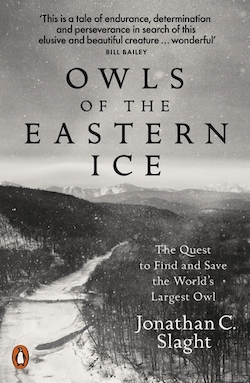
Published by Allen Lane / Ferrar, Strauss and Giroux, 2020, 348 pages
“This dishevelled mass of wood-chip brown regarded us warily with electric-yellow eyes. … It was clearly an owl, but bigger than any I’d seen, about the size of an eagle but fluffier and more portly, with enormous ear tufts. Backlit by the hazy gray of a winter sky, it seemed almost too big and too comical to be a real bird, as if someone had hastily glued fistfuls of feathers to a yearling bear, then propped the dazed beast in the tree.”
This is Jonathan C. Slaght’s first glimpse of a Blakiston’s fish owl (Ketupa blakistoni). He is in Primorye, a forest in south-eastern Russia, a vast expanse of green hills. No one had seen a fish owl this far south for a century.
Primorye is a special place for Slaght. He fell in love with it the first time he saw it, flying over the vast expanse of forests and hills. His work focuses on the area; for his PhD, he studies the fish owl and its habitat to help efforts to protect it. He speaks fluent Russian.
The fish owls in Russia share their habitat with the Amur tiger, but much less is known about them. The owls build their nests in the cavities of trees, so they need large (and therefore old) trees to nest in, and rivers that provide enough fish.
Slaght’s work is preservation; he makes the difference between conservation and preservation. Conservation would mean banning all logging and fishing in the area. But there are two million people there who make a living from both logging and fishing. Preservation is a way of allowing people their livelihoods while also protecting the owls: as he points out, humans and fish owls both depend on the same resources. Given that human use of local resources has escalated, Slaght’s aim is to bring back a balance in the relationship.
Slaght teams up with Sergey Avdeyuk, who researches fish owls in the region. This book is an account of their trips into the forest—mostly in winter and early spring—looking for fish owls, which are easier to hear than to see. The call of the owls is a duet that melds so seamlessly that you would think you are hearing just one bird. “Breathy, low, and organic, the call pulsed through the forest, hiding among the creaking trees and bending with the rushing river. It was the sound of something ancient and in its place.”
Their journeys bring them into contact with some of the people who live in the forest with whom they stay, eccentric men living in remote areas, sometimes to escape their past. Chepelov, who lives on the edge of the Samarga river, has probably the only toilet for hundreds of miles (the other huts have outhouses) and sleeps in a plywood tent on the second floor.
The area is full of history. They come across the village of Ulun-ga, now reduced to a single house with a dilapidated shed and a grove of cherry trees. The village was settled by Old Believers, who were liquidated by the Soviet government in the 1930s. For some reason, one house was left standing and serves as a hunting cabin for a one-eyed hunter.
Field research is not easy, especially in heavily forested and snowbound areas. Slaght, Sergey and their team live in dilapidated huts, spend hours in the cold, and cross rivers either by driving over the ice, barrelling through the water, or even walking across. And then there is the vodka. Custom dictates that if a bottle of vodka is placed on the table, it has to be finished that night. It is also a way of showing hospitality: as soon as the men have settled into their new quarters, someone arrives with a bottle of vodka to share. Slaght manages to slink off to his bunk to avoid the worst of it.
Slaght writes vividly and his enthusiasm for the owls is infectious. The team’s aim is to catch the owls and tag them so they can monitor their movements. They catch their first owl almost halfway through the book—after hearing them, sighting a few but not getting anywhere near one—and you feel the same triumph that they must have felt.
The effort to preserve the owls’ habitat is urgent. It is not only under threat from loggers but from natural disasters. Slaght returns to the forest in the aftermath of a 2016 typhoon (almost 10 years after he began his research there) to find it devastated—the trees that the owls used for nests have been destroyed. But the birds find the one tree still standing to nest in. In spite of the devastation, nature is finding its way back.
Although Slaght’s book focuses on fish owls, it is also a call for us to be more aware of our actions and how they affect the creatures we share our world with. Like these wonderful owls.
 Talking About Books
Sounds like a wonderful book
It is. It’s one that Saj bought and enjoyed reading. I didn’t even know that fish owls existed!
Pingback: Best Books of 2025 – Talking About Books
Pingback: On the Trail of Fish Owls: An Interview with Jonathan C. Slaght – Talking About Books