
Published by No Exit Press / Atria Books, 2023, 338 pages.
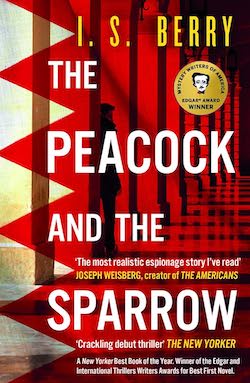
Shane Collins is a CIA spy, posted in Manama, Bahrain. He is coming to the end of his career and merely wants to see his final posting out.
But that is not what happens. He is running an informant—Rashid, who is part of Fourteen February, a movement to free Bahrain from its royal rulers. Shane speaks fluent Arabic, so is able to move between two worlds: the glossy Bahrain of the expats, and that of the local people.
Bombs go off in Adliya, a fashionable district, popular with expats. Shane immediately thinks that they were set off by Fourteen February, but Rashid had not warned him about them. When he gets to Adliya, he talks to an officer from the Ministry of the Interior, Walid Al Zain, who is in charge of the investigation. There has been one casualty—no Americans, Walid stresses—and, according to him, there were five bombs. Except that the fifth one goes off just as Shane is leaving the scene.
This ties in with what Rashid tells him later. That the bombs were planted there by the government, not meant to do any real damage, and the finger would naturally point to the rebels. The idea was to push the Americans into giving the government more arms to fight the rebels. Which is exactly what happens. That is why Walid knew there would be five bombs, although the fifth one only detonated later.
In the meantime, Shane goes to a gala at the Opera House and meets Almaisa, an artist with a scar on her face. He falls in love with her and, over a period of time, persuades her to go out with him. They become a couple and are seen at various events together. This does not go down well at the CIA headquarters at Langley. When Shane’s boss, Whitney—a young man at the beginning of a stellar career—informs them about Shane’s affair, Langley tells Shane to break it off. Which Shane has no intention of doing.
Shane is being pulled into Rashid’s and Almaisa’s world. When he is with Rashid at a demonstration, he joins in, although as a spy, he is not supposed to get involved. Shane’s loyalties begin to waver. After all, the American government is not exactly being above board either. Shane decides to act, make one grand gesture before he retires, and agrees to do Rashid a favour when he travels to Phnom Penh for work. And that changes everything.
Although Shane understands Bahrainis better than many of his colleagues, he is still very self-absorbed. There is very little genuine warmth in him: everyone is someone who can be used, even the woman he claims to love. He cannot escape who he really is. “Seducing a woman was not unlike wooing an informant: You divine her wants and needs, decode her vulnerabilities, align yourself (sometimes work against her if friction’s her thing), make yourself indispensable, fill the gaps and crevices. You do this until you know her better than yourself—better than she knows herself—until the only answer is yes.” Almaisa is not even her real name: it is the name he gives her.
I.S. Berry is an ex-CIA agent, who spent two years in Bahrain. Her descriptions are vivid, whether it is of the city, her characters’ lives, or the stark contrast between the glitzy world of the expats and the rich Bahrainis on one hand, and that of Rashid and Almaisa on the other. Berry is pretty scathing about the expats and their supercilious attitudes, their tawdry behaviour, as if being in Bahrain, with the money to live the good life, gives them the licence to behave as they like.
I enjoyed the book but am a bit ambivalent about it. I didn’t like Shane, but I think that is the point: you are not supposed to like him. He is the narrator, so you see Manama and Phnom Penh through his eyes. Everything seems shabby, the people, on the whole, untrustworthy. As I said before, he can’t escape who he is. The world of spies that Berry describes reminds me of John Le Carré’s George Smiley books: the same sense of disillusion and also, a certain kind of seediness.
It would also be interesting to read a book by a Bahraini to try to get another perspective of the country.
However, this is a good read and I enjoyed it. Berry nails the politics and its undercurrents, the manoeuvring that goes on behind the scenes. She also describes the damage that a single act can cause, and leaves the reader with a depressing thought: that power always corrupts.
 Talking About Books