
Published by Hutchinson Heinemann, 2024, 381 pages.
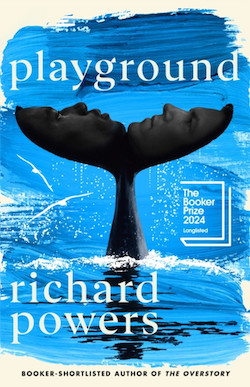
The ocean: a vast expanse that covers nearly 71 per cent of the earth. The deep sea still holds many mysteries and as we are discovering them, we are also destroying this habitat.
Playground follows four people whose lives are intertwined with the ocean: Todd Keane, a tech wizard billionaire; Rafi Young, a brilliant Black man from South Side Chicago; Ina Aroita, an artist from the Pacific islands, who meets Rafi and Todd in university; and Evelyne Beaulieu, a French-Canadian marine biologist, who is based on Sylvia Earle, an American oceanographer and author.
Rafi is a brilliant student and is sent to a private school, where he meets Todd. The two boys bond over games, especially Go, with which they become obsessed.
But that is not the only thing they share. Both their fathers are ambitious for their sons—Rafi’s father drills into him the need to do better than white people, while Todd’s father pushes him equally hard. Their lives at home aren’t easy: Todd’s parents are constantly fighting. Rafi’s father walks out, and his mother finds another man, who refuses to recognize Rafi’s intelligence.
Todd’s love for the ocean starts with a book called Clearly It Is Ocean, a book he reads as a child. He becomes a little obsessed with the writer, a woman who dives and opens up the fascinating underwater world to him. It provides him with an escape from his parents.
Rafi and Todd go to the same university, where they meet Ina, an artist, who has spent her life on naval bases on islands. The United States is the first time that Ina has set foot on a continent. Rafi and Todd both fall in love with her; she chooses Rafi. The men eventually fall out. Todd creates Playground, an online game that is also a social media site, which makes him a large fortune. Rafi stays on in university, trying to finish his thesis, which is stymied by his own impossibly high standards.
Then there is Evelyne—a French-Canadian woman, who helped to test the first aqualung as a child. She feels at home in the ocean, far more than she does on land or among people. The ocean is her passion, but to work as a marine biologist, she has to fight sexism. She marries Bart Mannis, who was her research partner. He works on land, looking after their twins, while she goes diving.
The story weaves back and forth between the characters at different stages of their lives. Todd’s narrative is the only one in first person, as he recounts his story and that of his friendship with Rafi. He has Dementia with Lewy Bodies, a condition that he knows will destroy him.
The book starts in the present, with Ina and Rafi living on Makatea in French Polynesia, with two children. The island is going to vote on an American project that will create modular floating city parts, which would be manufactured on the island. The idea behind it is that when the islands are unliveable, people will be able to live in these floating homes.
Makatea, which was once a thriving community of 3,000 people, is now reduced to 82, all within the space of a lifetime. The island was exploited for phosphate, and the mining, while it brought in money, had a devastating effect on its ecology. The debate on the island about the project is about priorities: which is more important, the financial rewards that would allow the island to have a proper school and healthcare, or the preservation of its natural habitat?
The project of building sea-steading homes on Makatea brings all four protagonists together. Evelyne, who is now 92 and on her own, has moved to the island and will be voting on the project. And one of the people behind the project is Todd Keane.
My summary does not do the book enough justice. It is rich and layered, and Richard Powers interweaves the lives of his characters with big issues, such as the impact of AI and the fate of oceans, as well as community and friendship. The dilemma facing Makatea is one that small islands worldwide have to contend with.
Powers’s passages on the ocean and its creatures are vivid and evocative. Evelyne and her colleagues dive down to inspect an old wreck and find that life has taken it over. “Life covered every inch of the twisted surfaces and turned them into high-rise dwellings. A brass ship’s throttle, its handle stuck to a speed that failed to save it, lay like some wild Miró sculpture caked in starfish and worms. Morays nested in the gun barrels…Nudibranchs slithered across bits of blasted deck as if some wedding had scattered hallucinogenic bouquets.”
He also writes about the humans—the ancestors of Pacific Islanders—who navigated the ocean’s vast expanse without compasses, maps or charts, in small hand-paddled canoes. “And they had leapt across this vastness so fast that islanders spoke languages that could still be understood by distant kin thousands of miles away. The world’s greatest seafarers still shared common myths, common tools, common customs, practices, and beliefs. A clan had spread across a third of the globe a thousand years and more before the West’s most advanced ships managed a single crossing.”
This expanse, which is so essential to our survival, is being destroyed by us. The levels of acidity are rising, and there is an enormous amount of plastic in the ocean. Ina, who makes art from things such as driftwood, starts to collect plastic from the beach on Makatea and creates a huge sculpture that seems endless.
The characters are nuanced and finely drawn, and you care about them. Powers understands relationships, whether it is Todd and Rafi’s friendship, a friendship that turns on itself; or Evelyne and Bart’s marriage, which takes time to settle into a routine and involves a lot of give and take.
I enjoyed Powers’s The Overstory, but I think this novel is even better. It is, in fact, a love letter to the ocean.
Playground is one of my best reads this year, and I can’t recommend it enough.
 Talking About Books
Pingback: The Overstory: Richard Powers – Talking About Books
Pingback: Best Books of 2025 – Talking About Books