
Published by Bloomsbury, 2020, 366 pages.
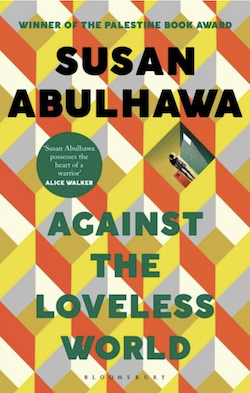
“This was what it meant to be exiled and disinherited—to straddle closed borders, never whole anywhere.”
“I know now that going from place to place is just something exiles have to do. Whatever the reason, the earth is never steady beneath our feet.”
Nahr, a Palestinian woman, sits in the Cube, a state-of-the-art prison in Israel, one that the Israeli authorities are happy to show off to journalists. But it is still a prison, a narrow space with grey cinderblock walls and a small, high window. Nahr has no control over anything—she cannot choose when to flush the toilet or run the shower. These happen independently of her, whether she is ready or not. If she misses the shower, she has to wait until the next time those in charge decide to turn it on.
Nahr has lost all sense of time. “The Cube is thus devoid of time. It contains, instead, a yawning stretch of something unnamed, without present, future, or past, which I fill with imagined or remembered life.”
And it is this life that she tells us about. How she grew up in Kuwait, in a ghetto where Palestinians lived after the Nakba, when they were forced to leave their land. She lived there with her parents, her brother Jehad and her grandmother. As a teenager, Nahr—named for the river her parents crossed as they fled Palestine—was not interested in her origins or in politics.
When she is 17, Nahr meets Mhammad, a fighter for the liberation of Palestine. They marry, but the marriage is nothing like what Nahr had imagined. Before long, he leaves her to go back to Palestine and does not return. He has secrets of his own, secrets that Nahr will discover much later.
That is when she meets Um Buraq, a woman who would have a big impact on her life. Um Buraq notices Nahr dancing at a friend’s wedding and strikes up a conversation. She is unlike any woman that Nahr knows: she is confident, and refuses to apologize for her status of being an abandoned first wife. Before long, Nahr is one of Um Buraq’s “girls”, working as a high-end escort. She earns far more than she does working in a beauty salon, and is able to take of her family. But there is a high price to pay: on her first night out, she is raped by one of the men.
Then Iraq invades Kuwait, and the Palestinians are accused of helping the invading forces. Jehad is going to Jordan to study medicine and will not leave without his family, but Nahr and her grandmother refuse to go. He is arrested, something that Nahr never forgives herself for. If she had agreed to leave, he would have been safe. After his release from prison, broken and physically weak, the family leave for Jordan.
Eventually, Nahr returns to Palestine—an undertaking in itself—to get a divorce from Mhammed. There she meets his brother Bilal and falls in love with him. She stays on, joins his group of close friends and becomes a part of their fight to free Palestine. The group meet in an underground room, away from the eyes of Israeli spies, who are everywhere. Eventually, she is arrested, and ends up in the Cube.
The characters are nuanced, especially Nahr and Um Buraq. Um Buraq is an intriguing figure, one I started out by disliking but was ambiguous about later. She is independent and unconventional in a society that expects women to follow convention. She uses her girls to make money, but also looks out for them. She teaches Nahr about the ways of the world and helps her family flee Kuwait. The women understand and trust each other and forge a relationship that goes beyond the escort business.
The book is structured around Nahr’s small living space in the Cube: the four walls, the floor and the roof. A description of each part of the Cube precedes a chapter of her life.
This is a harrowing read. The novel deals with different kinds of violence: institutional violence, sexual violence, and the violence of displacement, of the destruction of homes, lives and livelihoods—especially in Palestine. Israeli settlers setting fire to olive trees on Palestinian land during the harvest has become so commonplace that aid organizations have been set up to defend Palestinian farmers.
What I found heart-breaking and touching was the love between Nahr and Bilal. Unable to be together when they want to be, they finally find each other—both broken and scarred, but with a bond that remains strong. This love is reflected in the title of the novel, which is taken from James Baldwin’s letter to his nephew: “Here you were: to be loved. To be loved, baby, hard, at once, and forever, to strengthen you against the loveless world.” It is, in the end, what saves them.
Abulhawa’s love of her land and its people comes through in the section on Palestine, the place where Nahr finally feels at home.
She writes movingly about the pain of being an exile, and of fighting for the right just to live a normal life in the face of an enemy that is determined to prevent it.
This is not an easy read, and is not meant to be. The book was published in 2020, when things were hard in Palestine but nothing on the scale of the current destruction.
And given what is happening in Gaza now, this is a book that needs to be read.
 Talking About Books
Dear Suroor,
An excellent review. Its very moving and captures the horror of imprisonment so well. I read the book some years ago after I had finished Susan Abulhawa’s first book, Mornings in Jenin, which I still buy whenever I see it on second-hand shelves so that I can give it to people who know nothing about the history of the Occupation.
She writes so well and she’s a powerful speaker too. I heard her speak at Palestine House in London last year when she came back from Gaza. I don’t know how, but she had managed to attach herself to one of the British medical teams which went out. She was excellent – but even more devastating when she spoke at one of the Oxford debates a little later on. If you haven’t heard it, I certainly recommend it. https://www.youtube.com/watch?v=6eSDBNCt0xQ
She’s very active in the Palestinian cultural scene although it must be so difficult in the US to arrange anything at all now Trump is clamping down on any activism for Palestine. I would have loved to have gone to this Palestine Writes event. https://www.youtube.com/watch?v=nLpWMxg1GSw.
Its nothing like as bad as the US here – I go on all the Palestinian Solidarity marches in London and they are never less than 100,000 and up to 900,000 people – all ages and ethnicities and a great many Jewish signs as well saying “Holocaust survivor – Not in my Name”. Very peaceful with lots of babies in prams etc and rather bored looking police standing around on the side-lines. The Labour Government has been pushed into being far more critical of the Genocide than they were earlier. Partly because it is so appalling and there are far too many pictures of starving, bombed, displaced children on social media to be able to brush it out of the way. Our lily-livered Prime Minister had to say he would recognise the State of Palestine next month because over half the Labour MP’s voted in favour of it.
I have ordered the book “One Day Everyone Will Always Have Been Against This” by Omar Al Akkad which I believe is excellent. Its not a novel, but even the title says something important, I think. Votes for Women, US Civil Rights, The horror of Holocaust – our moral duty to support them all seem so self-evident these days – I think the world will feel the same about what has happened in Gaza in the not too distant future and those that are so mealy-mouthed will be embarrassed to have been on the wrong side of history.
Susie
Pingback: Best Books of 2025 – Talking About Books