
Translated from Japanese by Jim Rion.
Published by Pushkin Vertigo, 2023, 348 pages. Original version published in 1973.
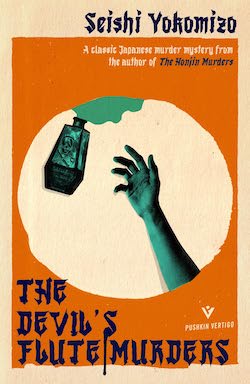
Japan 1947. The end of the Second World War has resulted in social upheaval, and the aristocracy has lost its privileges, which earns it the moniker of the “sunset clan”. This novel is about one of these families.
On 1 March, Viscount Hideusuke Tsubaki disappears. He walks out of his home without telling anyone where he is going. His body is discovered in Nagano Prefecture on 14 April. It looks like he has committed suicide.
Members of Hidesuke’s family travel to Nagano to identify the body: Mineko, his daughter; Toshihiko, the brother of Hidesuke’s wife’s Akiko; Kazuhiko, Toshihiko’s son; and Totaro Mishima, the orphaned son of Tsubaki’s friend, who lives with the family. There is no doubt that it is the viscount: his body has barely decomposed even though he was supposed to have died soon after he left his home, 45 days ago.
Later, Mineko finds a note from her father, implying that he had discovered something which, if it came out, would bring disgrace upon the Tsubaki family. “Oh, the devil will indeed come and play his flute. I cannot bear to live to see that day come.” She does not share the note with the others.
Hideusuke was a gentle man, a flautist and composer. His wife Akiko had inherited her family’s house, where they lived with Totaro, Akiko’s uncle Count Kimimaru Tamamushi and his girlfriend Kikue, and Akiko’s maid and constant companion Shino. Toshihiko and his family live in a small house in the grounds. Hidesuke never really fitted in with his wife’s family—both her brother and uncle are bullies, and her brother is feckless and depends on his sister for handouts. Hideusuke’s closest ally was his daughter, who loved him.
But then something strange happens, something that leads Mineko to consult private detective Kosuke Kindaichi. Kikue and Akiko go to the opera, where they are both convinced they have seen Hidesuke. This just confirms Akiko’s idea that her husband isn’t really dead but has come back to wreak vengeance on her. Akiko is child-like, self-centred and suggestible, and the thought of Hidesuke being alive terrifies her.
Mineko asks Kindaichi to find the truth behind what the women think they saw. She invites him to a divination being held in her home where all the people in the household will be present. The man carrying out the divination is Doctor Jusuke Mega, Akiko’s physician (and lover), a crude and unpleasant man.
The divination involves everyone sitting around the table in minimal light, with a dish of sand over which a cone is hung. This is where any sign from the beyond should appear. And it does: the sign of the devil. It is followed by Hidesuke’s last composition, “The Devil Comes and Plays His Flute”—a dissonant and tortured piece—wafting in from somewhere in the grounds. When the people rush out to look for the flautist, there is no one there. Later that night, Count Tamamushi is found dead in the room where the divination took place, a room locked from the inside.
And that is just the beginning. The plot twists and turns as Kindaichi tries to unravel this increasingly complicated mystery. Who is the mysterious flautist? And is Hidesuke really still alive?
I thoroughly enjoyed this book. Seishi Yokomizo captures what Japan must have been like after the war, creating a novel that is atmospheric and a bit weird (in a good way). I couldn’t put it down as the reveals kept coming—and the body count kept rising. Kindaichi is so vividly drawn that he feels real.
Some of the descriptions feel a little over-the-top for Anglophones. For example, when Mineko goes to see Kindaichi, there is a moment when she tells him something: “In that instant, Mineko’s face appeared to Kindaichi like that of a terrible witch, and the dark shadow that lay across her seemed to burst into raging black flames.” But that doesn’t happen a lot, and the description fits in with all the talk of the devil.
Yokomizo wrote a series of books with Kindaichi as the protagonist, and I am going to be reading more of them. They are absorbing and intriguing.
A great discovery.
 Talking About Books
Pingback: Best Books of 2025 – Talking About Books