
Translated from German by Daniel Bowles
Published by Serpent’s Tail, 2024, 190 pages. Original version published in 2021.
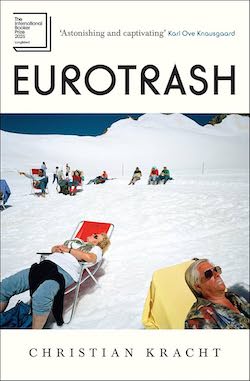
“So I shall go on a trip with her, I’d thought, and maybe it will be her last.”
A man takes his 80-year-old mother for a trip around their native Switzerland, revisiting places from their past—and in the process, giving away a huge fortune.
The mother has 13 or 14 million francs, which she got through shares in the cleaning business, and has invested the money mainly in the armaments industry and Swiss dairy farms. She decides to convert the shares invested in armaments into cash and “really give it away, get rid of it, squander it. To whomever, randomly.”
They hire a taxi for the journey. Mother and son have a lot of unresolved history between them, and they bicker constantly throughout the trip. Their cab driver is, in a sense, their audience. He even suggests writing a book based on what he has heard and has to be dissuaded from doing so.
The narrator, like the writer, is called Christian Kracht, and like the author, has written a book called Faserland, which makes this an autobiographical novel. He is middle-aged, multilingual, single and a bit of an intellectual snob. He has spent his life in various countries and continents, carrying his belongings with him, things that stay unused in storage units, almost as if he is fleeing his past while unable to let it go. When we meet him, he is back in Switzerland, visiting his old mother regularly. She does not keep well, has been in institutions and now lives on her own, getting by on cheap wine and medication.
She also has a history to reckon with. Her father was a Nazi, an SS officer who had been through the UK’s denazification process, a process that did not change him in the least but which he used to his advantage. After he died, they found sado-masochistic paraphernalia in his home.
The mother moved away from her family’s Nazi past and married a social democrat, who became the right-hand man of the publisher Axel Springer, and made enough money to keep himself and his family in luxurious surroundings. The couple are now divorced. Although Christian’s father does not actually appear in this story, he is vividly drawn—slight of build, elegant and resourceful, impressing with “his elegant demeanour and his nefariousness”. His son sees him as a social climber with his tailored suits and custom-made shoes. But “the stink of the German working class still clung to my father’s bespoke English suits, as did the affectations of a parvenu”.
The vivid descriptions of the characters is one of the book’s strengths. Christian’s mother is an unforgettable creation: scrappy, scruffy and needy but also with feelings and emotional scars that she carries deep within her.
There is a dry humour throughout. When mother and son go to the bank, they are refused entry. “I mean, how did this look: an old, half-drunk woman with bruises and greasy hair and bloodshot eyes clinging to her walker and heaving herself out of the elevator, her shadow of a son, and a couple of battered travel bags?” The attitude of the bank manager changes once she shows him her passport, and he realizes she is an important client. Madame is fussed over and asked if she would like a coffee. They walk away with 600,000 francs in notes of 1,000, stuffed into plastic bags.
Their journey is eventful. They think of giving the money to a commune but it looks a bit dodgy; try to hire a private plane, but the pilot tries to rob them; and offer a large sum to some startled Indian women at a restaurant high in the Alps—and get trapped in a cable car.
In spite of the constant arguing and trying to put each other down, there are moments of connection, of tenderness. When the mother’s colostomy bag needs changing, she cannot—or will not—do it, so her son has to overcome his distaste and change it for her. It is the mix of resentment and acrimony on one hand, and dependence and tenderness on the other, that makes their relationship so compelling. They can be rude and abrasive, but Kracht pulls you in, and you want their relationship to work.
The end is extremely moving, and because the book is not sentimental at all, it packs a punch and rounds out the novel.
Amid the unsentimentality, there is unexpected poetry. Christian says about himself, “I have always lived in dreams, among the ghosts of language.”
This is a book about the guilt that comes with wealth and privilege, and being on “the wrong side of history”, as Marcel Theroux wrote in The Guardian’s review of this book.
Unusual and very enjoyable.
 Talking About Books
Pingback: Best Books of 2025 – Talking About Books