
Published by Chatto & Windus, 2020, 124 pages
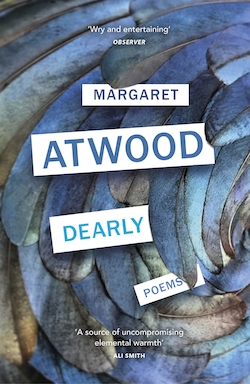
“Dearly beloved, gathered here together
in this closed drawer,
fading now, I miss you.
I miss the missing, those who left earlier.
I miss even those who are still here.
I miss you all dearly.
Dearly do I sorrow for you.”
“You can wander away. You can get lost.
Words can do that.”
—Dearly
These are poems of loss and absence, of empty spaces left when someone dies, leaves or fades away, absences left by words no longer used. These are also poems of memories and of endings. Atwood wrote them between 2008 and 2019, a time when “things got darker in the world”. People she loved died, including her partner Graeme Gibson to whom this collection is dedicated.
The title poem evokes things lost to time. Like the word dearly, “an old word, fading now”. Fading, like the photographs in an album, “everyone so much younger. / The Polaroids. / What’s a Polaroid? asks the newborn. / Newborn a decade ago.”
These are poems by someone looking back, remembering. Like the taste of the sweet water of a coconut she drank after the end of the Second World War, when you could get oranges again, and colour made a comeback. Or the souvenirs we bring back from our travels, the things that may be useless but tell our friends that we did think of them. Or old passports that we keep, “their corners / clipped”, with visas for trips that we barely remember taking. Or empty utensils, abandoned, “The pen reft of the hand”.
The book is split into five sections. In the second one, there are eight Songs for Murdered Sisters, songs of pain and rage. Songs for women killed by “men who thought they had the right”, by “fearful men / Who wanted to be taller”, who killed a woman simply “For being so alive”. The Dear Ones evokes the horrible feeling of loved ones not coming home, of the endless wait. Atwood writes about the pain in a way that feels visceral.
“You stop, but the sorrow goes on calling.
It leaves you and flies out
over the cold night fields,
searching and searching,
over the rivers,
over the emptied air.”
Atwood also writes about nature—feathers from a bird, probably shot down, a “calligraphy of wrecked wings”, and mushrooms bringing us news from below ground. And how we humans are destroying—and are continuing to destroy—our planet. The eight poems under Plasticene Suite are about how we are choking the world with plastic. Plastic that sprouts like foliage, “blooming…like waterlilies” but gives nothing back, plastic that leads to the death of a whale calf, whose mother carries her dead child for three days. What kind of world will our children grow up in? A world without birds, without crickets, pines or mosses?
There are werewolves, aliens, zombies and figures from mythology wandering through the pages. Cassandra considers turning down the gift of prophesying; and werewolves—who were once all male, behaving like frat boys—are now also female, going on the rampage before returning the next morning to their middle-management jobs, wondering about the hours they cannot account for.
But Atwood wouldn’t be Atwood without a sense of humour and playfulness creeping in. Musing about other people’s sex lives, she thinks “Surely not, we think”. Aliens arrive in all sorts of way, including through a 1955 hubcap in a garage somewhere, abducting humans through a “cosmic straw”.
I enjoy Atwood’s novels, and this is the first time I have read her poems. She writes in a way that speaks to me, makes me smile, and reminds me of loved ones I have lost and carry with me always. Her poetry feels immediate, like sitting down with a friend.
I loved this collection.
 Talking About Books
Thanks Suroor. I love Margaret Atwood always and her poetry is to the point. I’m looking forward to read this book
I am sure you’ll enjoy it!
Pingback: Best Books of 2025 – Talking About Books