
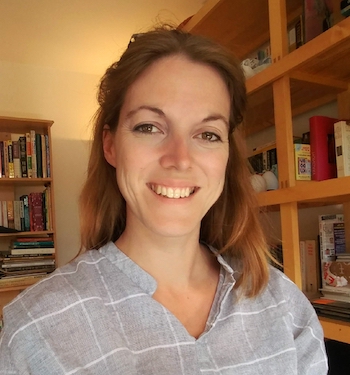
Rebecca Lowe is a British journalist specializing in the Middle East and human rights.
Her book, The Slow Road to Tehran: A Revelatory Bike Ride through Europe and the Middle East (2022), was shortlisted for the Edward Stanford Travel Book of the Year Award 2023.
Rebecca has written for the BBC, The Guardian, The Times, The Sunday Times, The Evening Standard, The Independent, The Economist, IranWire and HuffPost, plus a wide range of travel publications. She was previously the Senior Reporter at the International Bar Association, where she wrote about issues concerning human rights and the rule of law, and she is a Fellow at the Royal Geographical Society. She holds a BA from Cambridge University and an MA from Stanford University, where she was awarded a scholarship.
Talking About Books asked Rebecca about her trip cycling across Europe and the Middle East, and about the refugee camps she saw there.
TAB: In 2015, you cycled from London to Tehran. It was the year of Islamic State in the region, the civil war in Syria, and the migrant crisis. What made you undertake such a journey at this time?
RL: Two reasons: itchy feet and a desire to learn more about the people and communities of the Middle East. Part of me just wanted a big humdinger of an adventure before I settled down to have a family with my partner. But I also wanted to quit my journalism job (at the International Bar Association) and turn freelance, so I’d have more freedom to pursue the kinds of stories that interested me.
At the IBA I had written extensively about the Middle East and Arab Spring, but mainly from a top-down policy perspective; missing from the narrative, I felt, were the voices of the people themselves. This was not just an issue at the IBA; it’s an issue across the media as a whole. The mainstream news agenda tends to focus on political leaders, conflict and dynamics between countries—which is understandable, as you don’t want to bore readers to death with stories about the weather or what people ate for breakfast. But because they so frequently dominant the headlines, country leaders are often seen as a kind of shorthand for the character or culture of the people they lead—which, in dictatorships like those across the Middle East, is often not the case in reality. So Iran is viewed as a land of zealots because the regime is a brutal Islamist theocracy, whereas in reality it’s one of the most liberal and West-orientated countries in the region, with an astonishing culture of hospitality. My hope was to take a more “bottom-up” approach to reporting by speaking directly to the people themselves, and hopefully showing that there wasn’t as much to be scared of as readers of Western news outlets might assume.
TAB: What were the things that stood out for you during your trip? What were the highs and lows?
RL: One thing that stood out was the lack of judgement and hostility I faced. Here I was, a white, unmarried, agnostic British woman, whisking in and out of people’s lives and exploiting their hospitality while giving very little in return, yet even in the most conservative and remote areas I passed through people were almost always kind and respectful. Almost all condemned militant groups like Islamic State and Al Qaeda, and were clearly angry and frustrated at being held complicit for their actions. To me, there was a marked difference between the very private Islam I encountered inside people’s homes, which appeared warm, gentle and tolerant, and the very public Islamism we read about every day in the papers, which appears loud, aggressive and divisive.
It’s difficult to identify any specific highs, as there were so many, but one was probably the kebabs in Turkey and Iran (don’t ask me to say which were better as I have friendships in both countries I’d like to hold onto). I have long had a serious doner addiction—a medical ailment I’ve suffered from since my teens—and it was nothing short of bliss being surrounded by high quality, socially acceptable doner meat for weeks and months on end. Other highlights included sleeping outside in the Sahara every night, transported through both time and space as I lost myself in the infinite cloud-dust of stars overhead, and visiting the astonishing array of pyramids, tombs and archaeological remains scattered throughout the Nubian region in northern Sudan (Nubia was once more powerful than Ancient Egypt, though the history books are only now starting to take notice of this). Also: travelling through the wild, rugged mountains and wadis of Jordan, which is highly recommended for anyone keen to do a little cycling in the region, as you can cover the whole country in just a few days.
Lows included being chased by savage, drooling hounds all across the Balkans and Turkey (nothing to worry about, a guy reassured me in Sofia, as he “only knew two men who’d been killed by them”); running out of water in the Sahara and being rescued by some kind villagers after I collapsed on the outskirts of their village (note: if your mum advises you to “take enough water” into the desert, then best to listen to her); having a police escort for almost my entire journey through Egypt (for my own “protection”, but largely so the military apparatus could keep an eye on me); getting sexually harassed in Jordan, Egypt and Iran (not such a problem in urban areas, but a serious problem in the more remote regions); cycling through Istanbul (oh sweet jesus); and entering the suicidal maelstrom of central Tehran in the pitch black with a flat front tyre and no bike lights following a gruelling 160km ride in 48C heat (this still gives me willies).
TAB: You say that the journey was also to “take a good look at myself”, and to better understand the connections between the UK and the Middle East. What conclusions were you able to draw from your trip?
RL: I was very aware when starting the trip that I carried the weight of history with me. For hundreds of years, exploration and exploitation were largely synonymous for Western Europeans who ventured across the Middle East (and elsewhere) in order to dominate, conquer and control. Though well-meaning in intent, there was no denying that my trip was an exercise in privilege: an expression of social, political and economic freedom that others couldn’t share. I wanted to acknowledge this and maintain an awareness of it throughout my travels and writing. The issues and tensions we see in the Middle East today are largely a result of historical power dynamics dating back to the colonial period and beyond, and we therefore hold a certain amount of responsibility for the conflicts currently raging across the region. The war in Sudan; the civil unrest in Iran; the genocide in Gaza… we are complicit. So when you read in the media that people in the Middle East “hate” Britain or the West, there is a broader context here: they don’t hate us, as people; they hate what the political establishment has done to their country over generations of control and subjugation. Which is understandable, really, when you think about it.
TAB: You write in detail about the term “Middle East”. Is this term still relevant, given that it was first coined during the British Empire?
RL: The “Middle East” is a fascinatingly fuzzy term. Most people will have a strong idea in their minds of what it represents: i.e. conflict, repression, Islamism, terror etc., with values diametrically opposed to our own. But this is the tabloid image and bears little relation to reality. In fact, the region is far from a homogeneous sphere, but instead a vastly complex, diverse mosaic, often as different from itself as from those looking in from outside. Its borders have never been firmly delineated, even when the term was first coined at the turn of the twentieth century to replace the Ottoman-focused “Near East”, and the United States, United Kingdom, European Union and United Nations all still employ different definitions of what it actually means. Because of this, commentators often employ more useful, concrete terms like “the Arab world” or “the Islamic world”—but, of course, the former excludes Israel and Iran, while the latter extends far beyond the region into Africa and Asia. So it’s essentially meaningless as a definitive geographical moniker, yet it has strong political connotations depending on your personal perspective. Perhaps, broadly speaking, you could see it as a term used to refer to the cluster of Islamic countries (plus Israel) that have historically been caught up in the power battle between the West and Russia—and, as this is a battle that doesn’t seem to be dissipating anytime soon, I imagine it’s a term that’s here to stay.
TAB: You write about the refugee camps you visited along the way. Could you share some of your impressions of these camps?
RL: The most manifest evidence of the “privilege gap” mentioned above was arguably the refugee crisis, which was reaching its peak at the time of my trip. By the end of 2015, nearly five million people had fled Syria—twice the number of the previous year—and jihadist killings were on the rise. It bothered me that here I was, swanning my away across the region and being celebrated and applauded at every turn, while millions of others were embarking on far more challenging, courageous journeys in the other direction and being arrested, assaulted and abused.
Part of the reason for my trip was to try to gain some understanding of the plight of these people, so I organized visits to a number of Syrian and Palestinian camps across Bulgaria, Lebanon and Jordan. The Syrian camps were largely makeshift and informal, with people living ten to a tent in terrible conditions and lacking basic necessities such as food, healthcare and drinking water. But it was the Palestinian camps that I found the most shocking. These settlements were long-established, but were more like slums than proper shelters. Even at that time, nearly a decade ago, cuts to UNRWA (the UN agency for Palestinian refugees) were severe, and education, healthcare and other services were operating on a shoestring. The worst was the camp in Jerash, Jordan, built for refugees following the infamous Six-Day War in 1968, when Israel took control of Gaza, the West Bank and the Sinai Peninsula. Occupying less than a third of a square mile, the camp was home to 31,000 people (around 40,000 today), making it seven times as densely populated as London, and the streets were dirty, narrow and shrouded in shadow. Most residents were stateless, with no health insurance and limited education and employment rights, and many suffered from chronic medical conditions, respiratory illnesses and mental health issues. There was asbestos in the ceilings and strings of photos of Palestinian “martyrs” along every street, many of whom had been electrocuted by the jumbled mass of electricity cables and water pipes hanging overhead.
And that was then. I can hardly imagine, following the decimation of Gaza and dismantling of aid channels via UNRWA, how much worse it must be there today.
TAB: Your book was published in 2022, although you made your journey in 2015-16. How were you able to capture it in such detail? Had you already planned to write a book about your trip when you started out?
RL: I wish I had planned to write a book as it would have made the whole endeavour a lot easier! But no, this wasn’t my plan at the start; this only came about later, when an agent approached me six months or so after my return. But I did plan to write articles off the back of the trip, to kick off my freelancing career, so I made extensive notes every day, as well as writing regular blogs and taking lots of pictures. In a sense, I ended up with far too much information, as trying to unpick the narrative thread from a year’s worth of travel across three continents, while also weaving in a sense of the (intimidatingly lengthy) history of the region, proved very challenging. For anyone planning to write a travel book, I would say: keep the journey focused (one or two countries at most), and don’t spread yourself too thin. Or risk losing your sanity along the way.
TAB: How did writing a book differ from your other kinds of writing?
RL: Writing a book compared to writing articles is like comparing a marathon to a sprint. Or, perhaps, a hundred barefoot ultramarathons to a casual stroll down the park. It takes a wild amount of stamina and self-discipline, and a healthy dose of sado-masochism. If I’d known what I was getting myself into at the start, I probably would never have attempted it at all.
TAB: When did you first start to write? Has it been something you have always done?
RL: Weirdly, I’ve wanted to be a writer since I was five. I wrote my first book, Becky’s Book of Funny Poems, aged “7 ¾”, which was a true labour of love and contained such literary classics as “The Gallumphous Poo” and “My Brother and Other Pests”. Sadly, it wasn’t the publishing sensation I’d hoped for, though I remember that Sue at Hazlemere Library was a big fan. I do sometimes look back now at the prolific output of stories, poems and diaries I produced as a youngster and wish I could tap into some of that single-minded ease of expression today. But I guess that’s one of the challenges facing those who pursue creative endeavours into adulthood: how to convey the kinds of complex ideas and issues that come with age, while maintaining a sense of childhood vitality, originality and awe. Watch this space…
TAB: I will be looking out for your new writing! Thank you for taking the time to share your experiences.
Read my review of Rebecca Lowe’s book, The Slow Road to Tehran on Women on the Road.
You can follow Rebecca Lowe on Instagram (www.instagram.com/reo_lowe/) and Twitter (x.com/reo_lowe). Her book is available on Amazon (https://www.amazon.co.uk/dp/1914613287/).
 Talking About Books