
Translated from Bulgarian by Angela Rodel
Published by Weidenfeld & Nicolson, 2023, 304 pages. Original version published in 2020.
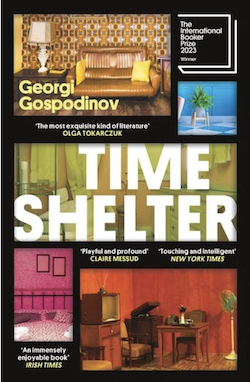
What if there was a way to turn back the clock and live in the past?
A geriatric psychiatrist called Gaustine, living in Zurich, believes that patients with dementia and Alzheimer’s can be helped by going into rooms that remind them of their lives as they once were. He puts his theory into practice by creating a “clinic of the past”, a building with rooms dedicated to certain decades.
Gaustine has paid scrupulous attention to the details in his clinic. The rooms from the past are meticulously laid out with artefacts from the period, even with the appropriate radio and TV programmes and even sometimes with items from the person’s life. When the narrator Georgi Gospodinov (who may, or may not be, the same person as this book’s author) is taken to his favourite period, the 60s, he recognizes the coat hanging on the coatrack as his mother’s. There is a collection of small cars and an Olivetti typewriter, which are also part of his past.
The therapy seems to work. People seem happier in the clinic and more engaged, and their memory returns. As Gaustine puts it, it helps them “re-member” memories that have become “dis-membered”. The success of the first one in Zurich leads to more clinics opening around Europe, including in Gospodinov’s country, Bulgaria.
Not everyone wants to go back to their past, however. One man chooses the life he never had, one he would have led if he had lived in the West instead of in Bulgaria. And not all memories are welcome: a woman who was in a Nazi concentration camp is terrified of showers, and her memories only bring back the trauma.
But what is memory? Is it what makes us, in a sense, real? “If we are not in someone else’s memory, do we even exist at all?” One of the cases Gaustine deals with is N., an old man who has lost his memory; he cannot remember anything about his life. But actually, there is someone who knows everything about his life. It is the agent who, for many years, was hired by the socialist state to follow him. The old man gets in touch with the agent so he can tell him about his life. In a strange twist, the enemy has become the keeper of his victim’s memories.
The clinics are just the beginning. Gaustine wants to create entire cities of the past, places that would welcome not only those suffering from dementia, but anyone who is tired of the current time—refugees from the present, so to speak. “A person is not built to live in the prison of one body and one time”, he says. And he himself seems to be moving through decades, bringing back artefacts from the past. Although the clinics are recreations, it is never clear whether Gaustine actually has the ability to time travel.
Soon, Gaustine’s idea spreads, and politicians get involved. They want to take their entire countries back to the past. Public referendums are held about which decade of the 20th century to go back to. National costumes are back in fashion, as is nationalism. Referendum campaigns are based on the availability of things from “free medical care to the taste of tomatoes and grandma’s chicken stew”.
Gospondinov takes us on a journey through Europe’s past, as we witness the referendums in various countries—with a bit of dry humour. “If Scandinavia couldn’t decide which of its happy periods to choose, Romania was also racked by doubt, but for opposite reasons.” He travels to Bulgaria to see how the referendum is going.
In Bulgaria, the contest is between the Movement for State Socialism, which is campaigning to go back to the socialist years, especially the 1960s and 1970s, and the Bulgarian Heroes, who want to go back to the April Uprising of 1876 (thus expanding the time frame to beyond the 20th century). People misremember the past—as people often do—seeing it as a golden age and forgetting everything that had gone wrong.
In the end, the bulk of Europe opts for the 1980s, with a few countries going for the 1960s and 1970s. Borders are drawn along time lines. “The old road maps became time maps.” But where will it all lead? If countries go back to the past, what will happen to the poetry and books that had not been yet written, for example?
Also, does Gaustine—the man who created the concept that changed the lives of so many people—actually exist?
The narrator Gospodinov says that Gaustine is his creation—“whom I first invented, and then met in flesh and blood”. So is he really only a figment of Gospodinov’s imagination or a persona of the narrator who is able do to what Gospodinov cannot or will not?
Georgi Gospodinov not only plays with time and memory, but also with concepts, such as the role of the author. This is clearly a novel, so he did create Gaustine and the idea of the time clinics. But the narrator Gospodinov is not clear about whether he created Gaustine or whether Gaustine already existed.
In the end, Gospodinov the narrator starts to lose his own memory. He is no longer sure how much of what he has just narrated is true. “Was there really such a clinic of the past, or was it just an idea, a note in a notebook, a scrap of newspaper I randomly came across. And whether this whole business about the coming of the past has already happened or whether it will start from tomorrow…”
This is a thoughtful book about nostalgia and memory, and how fragile and subjective our memories are and how the past can be manipulated to suit political purposes. Given the movements worldwide to take countries and people back to golden ages that never really existed, this feels very relevant.
 Talking About Books
Sounds like an absolutely fascinating book! Must read
It’s unusual. Won the International Booker in 2023.
Pingback: The Best Books of 2024 – Talking About Books
Pingback: Best Books of 2025 – Talking About Books