
Translated from French by Chris Andrews
Published by Serpent’s Tail, 2020, 146 pages. Original version published in 2017.
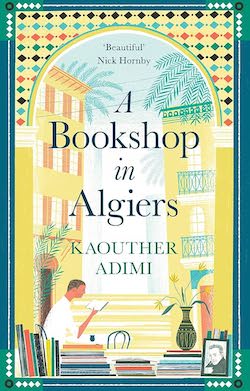
“This will be a library, a bookstore, a publishing house, but above all a place for friends who love the literature of the Mediterranean.”
1936, Algiers. Edmond Charlot, a Frenchman born in Algeria, opens a bookshop, Les Vraies Richesses (The True Riches), on rue Charras (later rue Hamadi) in Algiers. The space is cramped—seven by four yards—but it is all he can afford. Les Vraies Richesses will not just be a bookshop: it will also be a lending library, a publishing house and a place for people to meet.
It’s a booklover’s dream—and Charlot sees it through. He is the first publisher of Albert Camus, whom he knows, and of many other Mediterranean writers. Money is always a problem—Charlot can barely make ends meet.
But the bookshop survives for decades, through the French occupation of Algeria, World War II and Algeria’s independence. It is eventually converted into an annex of the National Library of Algiers. Then one day, it is sold to someone who is planning to convert it into a shop selling beignets. This means clearing it out.
This is the story of Charlot and his bookshop and, through them, of Algeria. Charlot and Les Vraies Richesses actually existed, and Charlot was a key figure in French literature. He was called up in 1939, during the Second World War, and had to return to France. In 1942, he was imprisoned for a month as a communist sympathizer.
In A Bookshop in Algiers, Kaouther Adimi quotes from what she imagines as Charlot’s diaries, interspersing it with the present, when a young man, Ryad, has been assigned to clear out the bookshop and get rid of its contents. The third thread is a narrative about events taking place in the country.
When the book begins, the French are still in Algeria. They see the Algerians as colourful natives, nothing more. Algerian schoolmasters are not allowed to wear the same uniform as their European counterparts: they have to wear “a fez with a violet tassel, an orange jacket, and a green belt. We are shown off because we look like figures from an oriental postcard; we become exotic in our own country.”
Some of the events Adimi writes about are not well-known: Sétif, 1945, a celebration to mark the end of the Second World War. Algerians are allowed to celebrate, as long as they don’t mix with Europeans—although several Algerians fought with the French, and many of them lost their lives. The crowd marches peacefully, holding up banners for independence, equality with the French, and the release of political prisoners. A policeman fires on them, and that starts a massacre that goes on for two weeks.
Paris, 1961, the massacre of Algerians protesting against a curfew imposed on them, with bodies being thrown into the river. “Don’t think twice: throw them over, into the Seine. Broken bodies. Beaten with rifle butts and batons.”
Charlot’s diary and his problems with his bookshop sometimes makes for a sharp contrast with the other narrative. He has problems finding paper and ink to print his books, but he is determined to provide a space for the people of Algiers which gives them access to books. He also has to deal with the egos of writers and their quarrels.
And then there is the story of Ryad, who hates books and writing, and is clearing out the bookshop. But this has always been more than a bookshop, and the people on rue Hamadi are not going to let him throw out the books like so much garbage. Abdallah, an old man from across the road, tries to educate him about the importance of books. Les Vraies Richesses has been a sort of home for him, and he wants it treated with respect.
Bringing these three timelines together builds up a picture of a country and of a man’s dreams to use literature to bring people together. At times it feels as if Charlot’s concerns are minor, compared to what the Algerians are going through, but the message of the book is that reading is important, literature is important. It is something that, on a personal level, I feel strongly about.
And given the state of the world today, it is a message that we should not forget.
 Talking About Books