
Published by Penguin, 228 pages. The Piano Lesson was first published in 1986. Joe Turner’s Come and Gone was first published in 1984. (Note: the dates of first publication are not clear; these may not be accurate.)
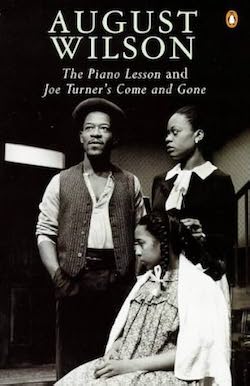
These two plays form part of August Wilson’s Pittsburgh Cycle, a series of 10 plays, each set in a decade of the 20th century, that chronicle the social changes taking place in the lives of the Black community. Almost all the plays are set in the working-class Hill District of Pittsburgh, where Wilson was born. To quote Wilson, “Put them all together, and you have a history.”
The Piano Lesson is set in 1936, just after the Great Depression. Berniece, a woman who lives with her uncle and her daughter, owns a piano with the faces of their family carved into it. The piano has a history—it used to belong to a white family, the Sutters, who “bought” it in exchange for two of their slaves: Berniece’s great-grandmother and her son. But Sutter’s wife missed her slaves so much that she asked Berniece’s great-grandfather to carve their faces on the piano. He not only carved their faces, but those of their ancestors too. Berniece’s father felt that, as long as the Sutters owned that piano, it would feel like they still owned his family. So he stole it from them and eventually paid with his life.
For Berniece, the piano is a part of her family’s past, a piano that has blood on it. But her brother Boy Willie sees it as something that serves a purpose: if it is not being played, then it can be sold. With the money, he can buy a plot of land (ironically, from the late Sutter’s son) and set himself up. Berniece will not play the piano nor will she part with it, and their quarrel over the piano drives the plot.
The play is about how people choose to deal with their pasts—either hang on to it or discard it and rebuild their lives. Boy Willie is determined to make a better life for himself. “All that’s in the past. If my daddy had seen where he could have traded that piano in for some land of his own, it wouldn’t be sitting up here now. He spent his whole life farming on somebody else’s land. I ain’t gonna do that.” But Berniece feels that the piano got her father killed, and therefore is not something you can just get rid of.
Joe Turner’s Come and Gone takes place in 1911, in a boarding house run by Seth and Bertha Holly. This was the period of the Great Migration, with the descendants of slaves moving north to start new lives. They “wander into the city. Isolated, cut off from memory, having forgotten the names of the gods and only guessing at their faces, they arrive dazed and stunned, their hearts kicking in their chests with a song worth singing. They arrive carrying Bibles and guitars, their pockets lined with dust and fresh hope…”
The boarding house is home to several transient people, many of them recently freed slaves. Among the guests at the boarding house are Herald Loomis and his young daughter Zonia. Loomis is looking for his wife Martha, and is haunted by memories of Joe Turner, the bounty hunter who enslaved him illegally for seven years. It was during this time that Martha left him.
The enslavement has created a sense of alienation in him, a feeling of worthlessness, and he wants to find Martha so that he can be healed. “Got to find her for myself. Find my starting place in the world. Find me a world I can fit in.” But as Byman—one of the residents of the boarding house, a “rootworker” who practices folk medicine—tells him, Joe Turner captured him because he wanted his song, the song that is who you are. “He thought by catching you he could learn that song. … Now he’s got you bound up to where you can’t sing your own song. Couldn’t sing it them seven years ‘cause you was afraid he would snatch it from under you. But you still got it. You just forgot how to sing it.”
Before Herald can find his place in the world again, he needs to find his song, he needs to find out who he really is, so that he can move on.
I have just outlined the plots of both plays. But they are both actually much richer than they might appear from my brief descriptions. Wilson is known as the “theatre’s poet of Black America”; the stories he tells are of people who are fighting for their dignity, for their place in the world: people whose stories are often left untold.
Denzel Washington is planning to film all of the plays in the Pittsburgh Cycle. He has made three so far: The Piano Lesson, Fences, and Ma Rainey’s Black Bottom, all of which are excellent. They led to me to read Wilson’s plays for myself.
Wilson’s writing is a pleasure: you connect with the characters and they move you. The plays reminded me of Lorraine Hansberry’s A Raisin in the Sun—powerful writing that tells of the struggles of Black people in the US trying to make their way in a world that does not make it easy for them.
Wilson’s plays are moving and heart-breaking, but to really experience them, you should see them performed. I would recommend not only reading them, but also watching the films or catching them at a theatre.
You will remember them for a long, long time.
 Talking About Books