
Translated from Spanish by Annie McDermott
Published by Charco Press, 2024, 99 pages. Original version published in 2021.
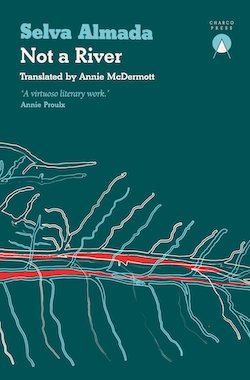
Three men go to an island in the Paraná Delta in Argentina to fish: two middle-aged men, El Negro and Enero, and a younger one, Tilo, son of their dead friend Eusebio. They are haunted by the death of Eusebio, who drowned many years ago on a trip just like this one.
They catch a ray which they hang up, eating some of it that night. They are visited by one of the men of the island, Aguirre, who comes to check them out. He is not exactly welcoming.
The next day, Enero finds that the ray is beginning to rot. He rows it out and throws it back into the water. When Aguirre finds out what he did—killed a creature for no real reason—it is the excuse he needs to deal with these men. They were never welcome on the island in the first place.
Meanwhile, Enero and Tilo meet two young girls, Mariela and Lucy, who invite them to a dance that night. But Aguirre, angry at the three men, has his own plans for them.
The book flows seamlessly between the past and the present, breaking the barriers between reality and the unreal. Enero, as a boy, keeps dreaming of finding a drowned man when swimming. When Eusebio takes him to his godfather, a healer, to explain the dreams, the godfather tells him he might be seeing something in the future, not realizing that it might be the death of his own godson.
In extremely spare writing, Selva Almada conveys whole lives—with pain, loss and love. There isn’t an extraneous word here. You feel the rhythm of the sentences, of the conversation of people who do not say much but feel deeply. Almada’s original version is steeped in the slang of Entre Ríos, a province of Argentina. It is beautifully translated by Annie McDermott and feels like it should be read aloud.
In a Translator’s Note at the end of the book, McDermott says that the way Almada uses language, the way she positions line breaks, makes the text seem like a river that ebbs and flows, “its short sentences lapping at the silence like waves on the shore”. That had not struck me when reading the book, but looking again at the shape of the text, she is right.
This is a slim novel that packs a punch. It stayed with me for a long time after I finished reading it.
 Talking About Books
Pingback: The Best Books of 2024 – Talking About Books
Pingback: Best Books of 2025 – Talking About Books