
Translated from German by Simon Pare, Seiriol Dafydd, Alice Paul and Jackie Smith.
Published by OneWorld, 2017, 390 pages. Original version published in 2016.
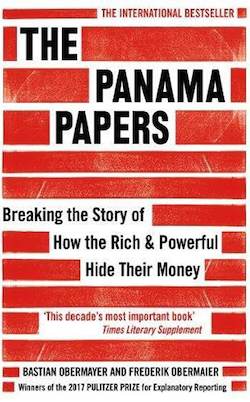
In 2016, the world was rocked by the scandal known as the Panama Papers, the revelation that many of the world’s richest people—including politicians, those in the worlds of entertainment and sports, as well as criminals—had been hiding their money in offshore accounts, using complicated arrangements to make sure that their wealth was not linked to them.
As the Guardian journalist Luke Harding says in his foreword, the shocking discovery was that the offshore account industry based in tax havens was not just a minor part of the economic system: it was the system. It was set up to help the rich avoid paying taxes.
These revelations were the result of a massive leak from a Panamanian law firm, Mossack Fonseca—a total of over 11.5 million documents, delivered over several months, making it the biggest leak ever. The person behind the leak remains anonymous to this day, known simply as John Doe. The data included emails, Excel sheets, letters and documents, implying that John Doe was working at MossFon; it was unlikely that anyone outside the firm would have access to this data, and the documents were being leaked in real time.
The first journalists to carry out the investigation were Bastian Obermayer and Frederik Obermaier of the German newspaper, Süddeutsche Zeitung (known as the Brothers Obermay/ier, although they’re not related). One evening in early 2015, Obermayer received a message from someone calling themselves John Doe: “Interested in data? I’m happy to share.”
It was an offer that Obermayer could not refuse. He never dreamed how big the project would become. The data kept coming. The Süddeutsche Zeitung got a larger computer, but the sheer volume of the documents meant that they could not handle it on their own. So the Obermay/iers approached the International Consortium of Investigative Journalists (ICIJ). The ICIJ took it on, and given the global nature of the data, were able to draw on journalists worldwide who were part of the consortium.
This is the story of the investigation into how Mossfon helped its clients set up shell companies in such a complicated way that it was almost impossible to unravel. It used false passports, fake directors, forged documents…anything was possible and nothing was sacred.
The leak was quite a coup: Mossfon was known to be “an inpenetrable wall, a black hole. Every time our research has led us to this law firm, it has spelled the end of the investigation. Mossack Fonseca is one of the largest providers of anonymous shell companies and is not exactly famed for being fussy about its clientele; quite the opposite, in fact.”
The clients included heads of state, footballers and other celebrities, and, of course, notorious criminals, including organized crime groups. In spite of Mossfon claiming to have certain standards, it was clear that no client was too nasty for them to handle—as long as they had money and plenty of it, Mossfon would help to hide it. “The heads of state are just the high-profile part of our story. We have also discovered known CIA defence contractors, offshore companies that manage oil deals for the Iranian regime and very wealthy supporters of US presidential candidates.”
At the time when the first data started arriving, there was a lawsuit in Nevada by an investment fund NML that had bought up Argentinian debt before the country went bankrupt. José María Campagnoli, a public prosecutor, thought that the then president Cristina Kirchner, and her late husband, smuggled $65 million out of the country, presumably with help from Mossfon. The NML lawsuit was to get Mossfon to surrender all the documents relating to the 123 shell companies that it had set up to help the Kirchners. Mossfon, as expected, was holding out—and now Obermayer was looking at these same documents that NML had been trying to get for years!
It took over a year to examine and analyse the vast quantities of data and join the dots. The story was finally published in April 2016: it had been agreed that the journalists around the world working on the story would publish on the same day. It was, as Harding puts it, one of the “moments in history when a big truth is suddenly revealed”.
You wouldn’t imagine that a book about financial transactions, no matter how nefarious, would be a gripping read (at least, I didn’t). But this is. From the arrival of the first batch of data to the story’s final publication, the book is utterly compelling.
Since the Panama Papers scandal came to light, governments around the world have managed to recover $1.2 billion (figures as of 2019).[1] Mossfon closed down two years after the revelations, but the two founding men behind the company, Jürgen Mossack and Ramón Fonseca, are still in Panama.[2]
You can read more about the Panama Papers investigation on the ICIJ website: https://www.icij.org/investigations/panama-papers/.
[1] See “Panama Papers helps recover more than $1.2 billion around the world”, ICIJ website, https://www.icij.org/investigations/panama-papers/panama-papers-helps-recover-more-than-1-2-billion-around-the-world/
[2] See “Where are the key Panama Papers figures, seven years later?”, ICIJ website, https://www.icij.org/investigations/panama-papers/where-are-they-now-2023/.
 Talking About Books
Pingback: Best Books of 2025 – Talking About Books