
Published by Faber & Faber, 2018, 348 pages.
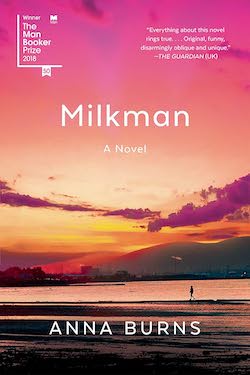
A town in Northern Ireland in the 1970s, during the Troubles. A time of suspicion, deep divisions and violence.
The unnamed narrator is an 18-year-old woman—referred to only as Middle Sister. She has mapped out a space for herself, staying out of political discussions. She avoids unnecessary contact by reading while walking (only 19th century books—she doesn’t like the 20th century). It is a form of protection because, as she says, “Knowledge didn’t guarantee power, safety or relief and often for some it meant the opposite of power, safety and relief”. But this “reading-while-walking” habit marks her out as different, which is not really a good thing in that climate.
She has a boyfriend, referred to as maybe-boyfriend: theirs was a “maybe-relationship, not a proper, committed, going-somewhere relationship”. Her two older sisters are married, and her mother nags her endlessly about following their example. But she isn’t ready to, so she keeps her boyfriend secret.
Everything goes on as normal until the milkman comes into her life. Not the real milkman who delivers milk to the community and who was brave enough not to allow guns to be buried in his garden, but a paramilitary man with some power. It all begins when she is returning home, reading as usual, and a car pulls up. It is the milkman, offering her a lift. She does not want a lift, and she does not want to have anything to do with this man. So she refuses his offer, and he drives on. The next day, her eldest sister comes to warn her because she has heard that the narrator had been seen with the milkman.
And then it snowballs. The gossip is unstoppable and everyone assumes that she is having an affair. Her denials are not believed. Her mother works herself up, warning the narrator about the perils of having an affair with a married man, and especially that married man. Her situation is not helped by the fact that the milkman keeps turning up unexpectedly and seems to know a lot about her and her family, even that she has a boyfriend, which—given the milkman’s reputation—worries her.
The book is about how this rumour, and the persistence of the milkman, seeps insidiously into the crevices of her life, taking away her self-confidence, affecting her relationships with her boyfriend and with those around her. Even though she tries to distance herself from the gossip and politics, she still gets sucked in. The fact that the town is in the midst of an ongoing conflict just exacerbates the situation.
“It was put about that I had regular engagements with him, rendezvous, intimate ‘dot dot dots’ at various ‘dot dot dot’ places. … we were partial, it was said, to spending time just the two of us—and presumably all the people who were spying on us—where the tall grasses grew over the ancient tombstones…”
This is a stream-of-consciousness narrative with a smart and caustic narrator who has a sense of humour and an eye for the absurd.
Anna Burns describes the atmosphere during the Troubles—the fear, the suspicions, the hair-trigger tensions, and the way people followed unspoken rules that everyone was aware of: what you could or could not say, who you could or could not meet, even the names you gave your children. And the way the entire community could turn on you at the slightest hint of transgression.
Shame, says the narrator, was more potent than any other emotion with “no way to grapple with or transcend it”. It needed numbers to make it effective, “regardless of whether you were the one doing the shaming, the one witnessing the shaming, or the one having the shame done unto you”. It is the portrait of a society governed by fear, a claustrophobic society—nothing you did was private and you could not shield yourself from what was around you.
To add to this, there is also the power play between men and women (fortunately, there are a few men who don’t buy into this, including maybe-boyfriend). This is what the narrator calls “‘I’m male and you’re female’ territory”. The milkman catches up with the narrator when she is running on her own and claims to be concerned about her, “Not sure…about this arunning, about all of that awalking. Too much arunning and awalking.” In other words, women should know their place and clearly, the narrator doesn’t.
I thought the fact that Burns does not name her characters, or even the town itself, would make this more of a generic story, one that could happen anywhere, but because her descriptions are so evocative, the story feels very specific.
My only gripe with it is that the stream-of-consciousness narrative gets a little tiresome towards the last third of the book.
But having said that, I thought it was a vividly drawn portrait of a particular period (and one I imagine, could portray any place in similar circumstances). Burns writes with a great deal of empathy and enough humour to stop the novel from becoming too heavy. Her book draws you into the world she creates, and is a cautionary tale about the dangers of unsubstantiated rumours, something that makes it very relevant today.
 Talking About Books