
Published by Hodder, 2014, 385 pages.
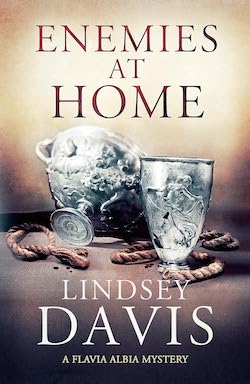
Rome, 89 AD, during the reign of Emperor Domitian.
Valerius Aviola and Mucia Lucilia, a recently married middle-aged couple, are found murdered in their rented ground-floor apartment. It seems to be a burglary gone wrong: a large quantity of silverware was taken, and the porter Nicostratus was badly beaten. Titianus, the investigator of the Second Cohort looking into the murder (the couple were wealthy enough to warrant an investigation into their deaths) blames the slaves—he believes it must have been an inside job.
He comes to this conclusion in spite of the fact that there were no complaints about the slaves behaving badly. It is merely a convenient solution. Slaves were particularly vulnerable—they had no rights and could be tortured, prosecuted and executed without any proof of their guilt being required. So, as soon the slaves of the Aviola household get wind of the accusation, they take refuge at the Temple of Ceres, where they would be provided sanctuary.
The temple officials—worried that they may be harbouring murderers—consult the aedile[1] Manlius Faustus, who asks Flavia Albia, an investigator, to take on the case.
Albia is an unusual Roman. For one, she is from Britain, rescued from the streets of Londonium by her adopted parents, Marcus Didius Falco and Helena Justina. Second, she is a female investigator—it was not always usual for women to work, and especially not as private investigators. But Albia chose to follow in her father’s footsteps.
Albia’s investigations raise more questions than they answer. Why wasn’t Nicostratus strangled like the couple? The slaves must have heard the couple cry out—why didn’t they rush to help them? And why did the slaves take Nicostratus with them to the temple—there was no way he could be accused of the crime. Were they worried about what he would let slip once he regained consciousness?
Albia also discovers that the couple were planning to sell some of their slaves, including Myla, whom Aviola was sleeping with. But the slaves are not the only suspects. Aviola’s first wife, Galla, was not happy about being supplanted in his affections by her best friend, Lucilia. Could she have hired the Rabirii, a family of career criminals, to kill the couple? Albia is determined to talk to someone from the Rabirii, in spite of dire warnings from Titianus that they are too dangerous to be messed with. Was it a murder made to look like a burglary?
This is a thoroughly enjoyable read. The Albia books follow Lindsey Davis’s Falco series, picking up the story 12 years after the last Falco novel, situating it in the reign of Emperor Domitian, a time of paranoia, suspicion and uncertainty, unlike the reign of his father Vespasian, which is the period the Falco books are set.
Albia is a delightful character: a young widow, feisty and street smart, not one to be cowed by any man. She had a difficult childhood, surviving on the streets of Londonium before Falco and Helena took her in. She is fiercely independent and views the world with a caustic eye.
Davis’s research is thorough, and her book is full of details about the period without being heavy handed. I learned a lot about how slaves were treated and how the system of freedmen worked. Also, seeing Rome through the eyes of a woman and an outsider brings a fresh perspective.
The romance between Albia and Faustus is nicely done, with humour—to my mind, an essential element in good romance writing—and enough tension to keep it interesting.
Each book in both the Falco and Flavia Albia series begins with a list of characters. These lists are not only helpful but also funny. Juventus, one of the investigators, is described as “anonymous, on special duties, do not ask”.
If you haven’t discovered these books, you should. This is the second in the series. I have now read the first three and intend to work my way through the rest.
The Falco books are among my favourite crime series, and the Flavia Albia series might just join him on that list!
[1] Roman elected official.
Read the Talking About Books interview with Lindsey Davis.
Read my review of Venus in Copper, the third in the Falco series.
 Talking About Books
Pingback: Venus in Copper: Lindsey Davis – Talking About Books